Celebrating over 1 Million Downloads and 50,000 Free CEUs on the Sound Bites® Podcast | NEW: Get 1 years’ worth of CEUs with the new 15-CEU Podcast Course
Journey of a Lifetime: Thriving with Type 1 Diabetes for Over Six Decades
I can never ever remember saying I wouldn’t do anything because I had diabetes.” – Jeanine Crouse
Imagine having type 1 diabetes, taking insulin and not being able to monitor your blood glucose levels at home until that technology was developed and made available to you thirty years after your diagnosis.
Today’s episode is a candid conversation with my best friend’s mom, Jeanine, about living with type 1 diabetes for over 65 years. She’s seen a lot of changes in diabetes treatment and management during that time – but says that she never felt like she couldn’t do something because she had diabetes.
This interview was recorded almost exactly six years ago. It has not been released until now.
Jeanine recently celebrated her 80th birthday and is doing very well. She adjusted to a new closed loop monitor and pump last year and still enjoys a variety of activities at her senior center – swimming, pickleball, bocce ball, biking, walking, cards and book club.
Tune into this episode to learn about Jeanine’s story including:
how being a home economist taught her skills that helped her manage diabetes
swimming and other exercise
prenatal care, pregnancy and delivery
having a positive attitude and outlook
Joslin Medal and research study
Peanut M-n-Ms and sweet corn
I have tried to explain to people that every single step I take or don’t take has an effect on what the diabetes does. Understanding how stress has an effect, or why I needed to eat at a certain time for example, and I would say, “Do you realize that every single movement I make, every single food I eat, every bite I put in my mouth – it affects me somehow?” I don’t say that very often, but one time I was really upset because I was being judged for having diabetes.” – Jeanine Crouse
Jeanine Crouse
Jeanine Crouse was born in 1943. She grew up with five siblings on a farm in Garwin, Iowa. At the age of 13 she was diagnosed with Type 1 diabetes. Managing her diabetes has been a lifelong challenge, but it has not held her back from living life to its fullest. In addition to helping on the farm, Jeanine participated in 4H and played basketball in high school. She earned a degree in Home Economics from Iowa State University. She worked as a teacher and later, as a Business Analyst at an insurance company. She married, raised two children and after getting divorced and remarried, she helped raise two more stepdaughters.
Over the years Jeanine kept up with new information and advancements in technology for diabetes management. She went from rudimentary urine glucose testing and insulin injections in the early days, to finger-prick blood testing and an insulin pump. In the last year, she learned to use a new closed-loop system that continuously tests her blood glucose levels and calculates her insulin needs.
Jeanine wanted to help others and contribute to diabetes research, so in 2008 she became a participant in the Joslin Diabetes Center Medalist Study. The program studies people living with Type 1 diabetes for at least 50 years in the hopes of identifying protective factors that prevent the severe complications that come with diabetes. Because of managing her disease so well for so many years, she has been able to participate in several of their studies. Jeanine received a 50-year medal from the Joslin Center to acknowledge her living with diabetes for at least 50 years.
Jeanine manages her diabetes and stays active in her senior living community. She enjoys activities such as sewing, swimming, pickleball, biking, bocce ball, book club, and playing cards. Jeanine recently celebrated her 80th birthday with friends and family. She hopes to earn the next medal offered by Joslin in the next few years – a 70-year medal.
Melissa and Jeanine at a Diabetes Language video shoot for ADCES in 2018
[00:00:00] Melissa: Hello, and welcome to the Sound Bites podcast. So if you’re a regular listener, I’ve sprinkled in some interviews with people about diabetes, because it’s my favorite thing to do is to work with people with diabetes and empower them to live a healthy and happy life. So today is a very special episode because I am sitting in my best friend’s mother’s home in Naperville, Illinois.
We have been talking about doing this for a really long time. Her name is Jeanine Crouse. And she’s like a second mom to me. Jeanine, welcome to the show.
Jeanine: Thank you.
Melissa: I can’t even remember the first time we met because I don’t even remember the first time I met your daughter, Laura, who’s my BFF. I know that we met in second grade because that’s when we moved to Freeport.
And I remember you coming into school, I don’t know if it was second or third grade, and making bread. And that was fun. But most of all, I remember spending a lot of time at your house. Lots of overnights, and of course, Laura came to our house a lot as well. But, we were the Bobsy Twins, and if, if it was weekends, birthdays, Halloween, whatever, we were at either your house or my house.
And I know along the way, I found out that you had type 1 diabetes, and one of my favorite memories is you had this, I haven’t run this by you yet, but you had this, stash of peanut M& Ms, and I remember Laura would say, those are for my mom’s diabetes, so we couldn’t eat them, but I have a confession, we did get into them a little bit here and there, but we would only take a few because You needed them for your diabetes, so I’m not sure what that was all about, but I have a lot of questions for you.
I want to hear all about what diabetes has been like for you. You have type 1, you were diagnosed when you were 13.
Yes.
And you’re now 74, which you’ve given me permission to share on the podcast. So, let’s go back to When you were first diagnosed. Now, you have three sisters and two brothers.
Where do you fall in the family?
[00:02:11] Jeanine: I’m in the middle. I’m the third to the oldest.
[00:02:15] Melissa: Okay. So you were 13 when you were diagnosed. And do any of your other siblings, family members have diabetes?
No.
Okay. So tell me what you remember about that time.
[00:02:26] Jeanine: personally, I’ve certainly asked my siblings about what they remembered and it wasn’t too much.
it was just having, it made a difference, in some things that my mother had to do, but really nothing that my siblings had to take care of, because I was 13 and I took care of everything myself.
[00:02:56] Melissa: Yeah, do you remember, I assume, you were in the hospital, do you remember not feeling well, do you remember…
[00:03:05] Jeanine: I remember, I found out in June that I had it, so the few months before that was… Graduating from eighth grade and in a small town in Iowa, it was a big deal to graduate from eighth grade. we got dressed up and everything. And I had this dress, I remember, that was very fitted. This was in 1957 and it just was a fitted dress.
And I remember having to keep taking it in because I kept losing weight. And I don’t know that anybody, I was really skinny anyway, and I was really tall, so I don’t know if anybody, that was a deal, but one of the things that physically, I remember being so tired, and we, all of us would help my mom hang up clothes outside on the lines, and I would always, after I hung up, a basket of clothes, I would have to come in and lay down on the couch, I was just so exhausted.
I don’t remember the – I’m sure I drank a lot of water and, was thirsty. I don’t remember that, specifically now, but, 60 years is 60 years. and going to the bathroom a lot, I’m sure that was, there too. So those are, to me, the symptoms. Losing weight was part of it, and just getting thinner.
I don’t think that I, was stepping on the scale and knowing what I was doing that way, but I just know that I was getting thinner.
[00:04:41] Melissa: And like you said, you’re tall. How tall are you now?
[00:04:44] Jeanine: now I’m 5’10 but I was 5’11 1 2 and so at that time in 8th grade, I probably would have been close to 5’10 at least, if not, my full height, I don’t know, 13 could have been.
And you’ve always been slender.
[00:04:58] Melissa: Yeah. But you were getting really skinny then. Yeah, I was. Do you remember going to the hospital?
[00:05:05] Jeanine: I remember that one of the… ways when I had to, know for sure, or had somebody that had a record of when specifically by a certain activity that was happening besides my eighth grade graduation, but a cousin got married and it was the day after she got married when my parents, and I don’t know when they decided this, that they needed to take me to the doctor and see what was going on.
And this was in the middle of June. So that’s what they did. They took me and right away, all I remember was that I was put in the hospital. No blood sugar. They didn’t tell me. And I don’t think I ever saw it in any, I don’t think I ever had a record from that doctor.
[00:05:52] Melissa: Do you remember how long you were in the hospital?
[00:05:53] Jeanine:
Oh, probably a week. it was a big town, so to speak, and people would come and visit, and…
You remember that.
And I, I don’t even remember, feeling, I didn’t feel really bad, but I think, I still go back to the losing weight and, those symptoms that…
I must have had it for a while for those things to have transpired.
[00:06:20] Melissa: Do you remember anything about, obviously, as a type 1, you had to start on insulin. Do you remember learning that in the hospital, going home on that?
[00:06:31] Jeanine: yeah, with the orange. They did the orange back then? Yeah, they did the orange.
Yeah, and I remember, taking the shots myself first time. And again, the kind of, one of your other people that you talked to before talked about the, dips in the leg. Oh, the ketone testing? No, When you, when the body, Oh, the hyperlipotrophy. Yeah. Something.
Yeah, I had a lot of that and I only did it in my legs, sometimes in my hips,
[00:07:06] Melissa: but You started getting the little divots
[00:07:08] Jeanine: in your Yeah, I would and I played basketball in Iowa, girls play basketball Especially tall ones Yeah, especially tall ones. And I remember the pictures of me with, in the picture of the team And you could see in my legs the
[00:07:27] Melissa: dimpling Yeah The divots, Yeah Okay, so you were going into your freshman year of high school when this was all happening.
That is a hard enough transition. Do you remember just adding more to that transition or was it this is my life now?
[00:07:42] Jeanine: Yeah, that’s, I always treated, I must have always treated it like it’s just something that happened that you have to take care of and you have to do. I don’t ever, and this, really truthfully, sometimes you go, really, you never did that? You never said you’re not gonna, no, you didn’t want to, or you rebelled against it, but I never did that.
Wow.
I never did that. And maybe it was just. the kind of family you grew up in, you just go with the flow and go with what’s happening.
Yeah,
[00:08:16] Melissa: especially going into those teen years, we do expect some sort of rebellion.
[00:08:21] Jeanine: and you don’t know, I may have rebelled in other ways, but I don’t remember with the diabetes. Because, you know that you’re the only one that can do it, really. my mom tried, back then in the late fifties, the kind of food that was available for diabetics was, and the kind of sweeteners that were available.
They weren’t always so flavorful and tasty, but I just knew, and my mom would always make me, she was a big Jell O maker, of course, back then, and, she always made me Jell O that was, sugar free. She always made the other because she, had a big family. There were six kids in the family, and so she had a big family to feed and she wasn’t gonna feed them sugar-free jello, which is what I did when I was cooking for my family almost all the time.
Yeah. I wanna talk about that too. But, yeah, so it was like, that’s Jeanine’s jello. Yeah. And they knew that, they, didn’t want it anyway. They wouldn’t even care , they, would not even, they knew that it wasn’t as good as what they would get.
[00:09:32] Melissa: And did
that make you jealous?
[00:09:35] Jeanine: Or you’re just like, I don’t know,
just what it is. Yeah.
[00:09:39] Melissa: so was your mom a homemaker?
[00:09:40] Jeanine: Yes.
[00:09:44] Melissa: Besides the, and I’m going to use this term because you use it, besides the diabetic foods, I was just talking with you before we started the recording, the American Association of Diabetes Educators has recently come out with some new language.
We’ve known for years that calling someone diabetic is a little less than sensitive, but if you have diabetes and you use that term, that’s, your choice. But this new language, and I’ll put a link to this in my show notes at soundbitesrd. com, it’s just really came out in the last couple of months.
But it goes quite in depth on, and I didn’t bring it with me, I don’t have it in front of me, but it goes quite in depth into just ways to be sensitive when you’re talking with someone with diabetes. And so I want to get your take on that. We set the stage with like your personality or your experience was, it is what it is.
This is what I need to do to take care of myself. I’m 13, going on 30. And it’s up to me, but as you went through high school and maybe even into college, did you ever feel judged or any language that people used towards your condition?
[00:10:56] Jeanine: No, not really. if somebody would have said you’re diabetic, I probably would have just went, Yeah, I am.
only because. We didn’t think about, maybe back then, as sensitive, because I wouldn’t say that now, and most of the time, I would say something, like with food, I would say it’s sugar free, not that it’s for a diabetic. I wouldn’t say that. Yeah, I think if, ever I have, and oftentimes I don’t, if I bring
Something that I’ve made without sugar to a gathering, and I know there are other people there that have diabetes. Sometimes I might tell them, but a lot of people in the type 2, so that would be in the type 2 realm, I’m saying, because of my age, that’s, I see a lot of seniors that have type 2, and If I know them well enough, I would want to say I brought something that doesn’t have as much sugar in it.
It’s never sugar free things. Companies try to make foods that are sugar free. that’s not true. There’s always carbs in it someplace. And I try and measure always what I make so that I know how many carbs is in something. because I want certain things and can make it and figure out what the carbs are.
[00:12:21] Melissa: I
remember, I think of you as a cook and a baker. I remember not just the bread, but I’d go to your house and Laura and I would make a pizza from scratch. And I remember breakfast. it was very different than breakfast at my house. Breakfast was like this balanced meal. Maybe there was a little piece of toast that was homemade bread of yours, which was amazing.
And maybe some egg and a little glass of juice. in my house, it was cereal and milk and, several bowls. And I think that’s the one thing that stuck out to me the most, not necessarily, like types of food or anything. And of course, the stash of peanut M& Ms, I remember that as well.
[00:13:05] Jeanine:
Which is probably not something I should have been doing,
[00:13:08] Melissa: but let’s talk
about that. My guess, as a CDE for 20 years is that was a treat that you liked, but my impression when Laura said, that’s for my mom’s diabetes, it’s off limits. Was something like, if you were having a low blood sugar, not that you would take it to treat a low blood sugar, but once you treated your low blood sugar, that was something that you enjoyed to help sustain it.
Yeah,
[00:13:33] Jeanine: probably, but
Melissa: I’m, giving you an out here.
Jeanine: No, I’m just, no, that’s perfectly fine. But in reality, the whole 60 years, I’m sure. That once you get that feeling of being low, that you know you’re low, and this was like, I’m throwing a lot of things in here that are not in, in order, but for the first thirty years of being a diabetic, I had no idea what my blood sugar was.
Thirty years and not even knowing unless you went to the doctor.
[00:14:04] Melissa: Okay,
let’s talk about that because that’s one of the things, one of the reasons I wanted to talk to you. Not only have you had diabetes type 1 for 60 years, and you’ve actually received a Joslin award, which I want to talk about, and you’ve actually done some research when you were out in Boston at Joslin, or you participated in a research study, things have changed so much over the years.
There wasn’t a little monitor that you had where you check your blood sugars at home. did you check your ketones? Yeah,
[00:14:35] Jeanine: With the urine? there was, I checked, with the blood sugar with the stick. I also had tablets that you did at one time. Okay. Both of those, but, they were I guess they worked.
I just don’t know. Hey, different than having a blood test. once you know a specific number, it’s different than looking at a test strip and this could be between this number. I can’t even think what they were now, how they ran. I know they. Ran like you’re 200 or above, it was bright orange or bright something, and then if it was green, you were okay, and then there was this in between.
Right.
[00:15:19] Melissa: So do you remember, if you didn’t have a number to put to how you felt, do you think you knew when you were feeling low or feeling high, or did you not have anything, you knew that?
[00:15:30] Jeanine: I knew for sure. When I was feeling low because I would, I don’t do this anymore. The shaking business, my hands would shake and what else?
I think also, this happens now too, that when the brain is not getting sugar, when your sugar’s too low, there are indications of. Not mentally, I’m not exactly the right word to use, being accurate’s not the right word.
Melissa: You feel a little confused or fuzzy. Confused, yeah, fuzzy, yeah.
Jeanine: Oh, I know, the worst thing is not being able to make a decision. here you are, you know you’re low, and you’re supposed to eat something, and you should, of course, should is a big, word, big nasty word, to use should, but… You should eat a fast acting blood sugar. Now, one of the… You mean, fast acting carbohydrate.
Blood sugar, yeah. Fast acting carbohydrate. Now, I remember when I was growing up, orange juice was the keystone to do that. that was it. I’m not so sure that people say that anymore because there’s something about it. I can’t, I just read that and I can’t remember what it is.
[00:16:46] Melissa: Yeah, orange juice has fructose in it, which is the fruit sugar, which actually doesn’t bring your blood sugar up as quickly as just glucose.
[00:16:55] Jeanine: Yeah, like a tab, like a glucose tablet would be the perfect. And so I know that there are the glucose tablets, of course, but I really didn’t like those things. And I… I really don’t like them to this day, but I have some in my house all the time, and I use them if I go below a certain number, because I usually take my tests now and know what I’m at, if it’s below a certain number, I will do glucose, and I also use Fruit snacks in the packet of, there’s 20 carbs in one packet, and so I just eat the whole thing, and that brings me up pretty fast.
Yeah. My friend Toby Smithson, who I interviewed, which is one of the episodes I think you listened to, she uses
Smarties.
[00:17:53] Jeanine:
but the problem, and to continue with that, is that just because, and I don’t remember when I was growing up, I probably would overdo it.
That is I just think that’s just me. Take too much carbohydrate. Yes. And I’m saying that wrong, that I’m not, but I think a person with diabetes. Your body is craving, it wants something, some sugar, and just because you’ve given it some, it isn’t working, especially if you’ve given it the wrong kind.
[00:18:56] Melissa: So then you feel like you need more because you’re not feeling better.
[00:19:00] Jeanine: I did that with my daughter Debra once when she was in high school getting senior pictures and we went to get them to decide, I think was the deal we were doing. And I started getting a reaction. Started going low. I started going low and I would have had a testing kit and I can’t, that hardly made a difference.
I felt the low. And why didn’t I don’t even remember if I didn’t have anything. Debra would probably remember this explicitly, what happened. But we went someplace to get ice cream, like a soft serve ice cream. that’s not really the best thing, but that is what I wanted then. And I wanted, that’s the only thing I wanted.
And I had the poor girl crying before that was over because I was making a scene, saying that’s not what I wanted. I wanted nuts on this. I, I was asking for ridiculous stuff because I just, my brain was just like, right? Not. And I think she’s forgiven.
[00:20:01] Melissa: I’m sure she has. Now, I know over the years, you can have hypoglycemia unawareness.
Do you still feel when you’re going low?
[00:20:11] Jeanine: I
But not in the same way. It’s different, it’s changed. Yeah, it’s different.
[00:20:18] Melissa: But there’s still… Like those later symptoms. Yeah. Like those initial
[00:20:22] Jeanine: symptoms maybe? Yeah, it’s more the, it is more the later probably. like especially the, not being able to make decisions and just…
People that are around me, so if I’m alone, I, I’m, I am alone most of the time, but when I have one, if people are around me and it’s family and they know me, they might say something, but just in general population, nobody, if I was in a store and I, they just think you’re weird Jeanine, they wouldn’t, yeah, really?
And I guess I wanted to say, I don’t know. Except for trying to be disciplined about it, which is not always helpful, which is not, which doesn’t always work when you are low, just so it’s just a constant thing. all the time, but even if you treat
[00:21:14] Melissa: it properly,
[00:21:15] Jeanine: right? So I’ve done this. I get a low, I know what it is.
I’ve taken my test and I’m doing the correct treatment. And then I go, man, I still feel like I need something. So then I, grab something sweet out of the cupboard somehow, and there are still sweet things in my cupboard. And then, later I’m 200, 300, and I know that, I know what I’ve done.
it’s just what it is.
[00:21:49] Melissa: So obviously you were doing insulin injections. and we already said, the first 30 years you weren’t even able to monitor your own blood sugars. So you were in your forties before you had a blood sugar monitor that you could do at home?
[00:22:03] Jeanine: Yes, I think it was in the, it was about that.
Exactly.
[00:22:10] Melissa: so that would have been, I’m
[00:22:11] Jeanine: trying to, It was in the mid eighties, but I’m, I was pretty sure it was in the mid 80s. Okay.
[00:22:17] Melissa: Maybe you did check your blood sugar in front of me, but we moved away from Freeport after my freshman year of high school. Oh yeah. So that was, right around the mid 80s.
Yeah. So I don’t remember you ever… Yeah, I’m sure I probably saw you give yourself injections at
[00:22:30] Jeanine: some point. Yeah, I was not. I just did it.
[00:22:36] Melissa: So you had your insulin regimen and you were relying on how you felt as far as highs and lows. Yeah. And how many shots a day were you doing?
[00:22:43] Jeanine: at the beginning, it was just NPH.
Then there, they gave me a little PZI, a little, I don’t know what that means, but. I don’t even know what that is. protamine zinc. Oh. That’s what the, 60s. Yeah, and it was when I was pregnant. Oh.
And they wanted me to have whatever. I don’t know why somebody decided that. And then after. The girls were born, then I went on, those were two separate shots, they couldn’t be taken together. You couldn’t combine those. Then I went on NPH and regular, and those could be combined, both taken in the morning. And I took a certain, And there was a period, about 20 years, I guess it was when I, about when I was in my early thirties, where my body changed in the way it was reacting to insulin, how much it needed, what I was taking, and it was around the time that you were maybe first, so Laura would have, you guys would have been about nine or ten, and I wasn’t waking up in the morning.
My husband would already have left for work. I guess he couldn’t wake me up, but he just left me, no, I don’t, and, I lost the feeling on one side of my body for a while. anyway, within a short period of time, I went up to Madison. Rather than it was a small town I was in and we went to see an endocrinologist up there because I’d never been to an endocrinologist before it just you know family practice stuff Anyway, they cut my insulin in third a third.
I mean they took a third off of it. So I had 30 And they put me down to 20, and then I was on that. Now, it always changes. Now, it’s constant changing. But that was interesting, an interesting time. And I’m trying to think of that lasted until it was in the mid 80s when the, what did they call that?
There was a study done on diabetics. And if you test more often, Multiple daily injection? it was, that’s what the result of it was, but it was determined then that you should do more shots. Oh, I know, it’s called intensive insulin therapy. I’m sorry, I did have that down.
That’s when things changed a lot.
That’s when things changed a lot. And that was in the late 90s, I think. Because I was on NPH and regular for a long, 20 years, let’s say.
Jeanine: So I did an in the evening, an evening meal, this ultra lente I took And then I did Humalog. Then I started taking Lantus at bedtime and. NovaLog for the intensive insulin therapy whenever I ate with my meals.
PUMP Tx
[00:26:10] Melissa: And you’re on a pump now. When did you go on the pump?
[00:26:13] Jeanine: Now I’m on a pump. I’ve been on a pump since 2003, so about 14 years.
Do you like it?
Yes. And I resisted that.
I remember my mom. My mom died in 2001. And I remember she kept saying to me, cause she knew somebody who had a daughter that was diabetic in our little town. And she said, she’s on an insulin pump. and I went, I’m just, I’m doing really good, with this. And, I was doing okay.
Yeah. And I just didn’t think I wanted something attached to me and how, what, that’s what people say. Yeah. And, you’re doing okay. And I suppose it took me, it was, really, it was the only time I had to go to the hospital for diabetes. And. I took the wrong insulin instead of Lantus, I took regular and I went to bed and thank goodness my husband was still alive then.
He was alive for three or four more years after that, but he just heard me moaning and groaning in bed and he couldn’t wake me up. And he didn’t know how to test me, but when he couldn’t get me to eat anything, I wouldn’t take juice. I wouldn’t do anything. Now, I had an incident, of that same kind of thing about 20 years after I had diabetes where I also couldn’t be awoken and It just, it worked itself out. Wow. it worked itself out with, I finally started taking whatever, it was my first husband, whatever he was trying to give me. But we had done a whole bunch of exercise that day. And it had to do with that kind of thing. But this was an actual error on my part.
And I could have fixed that. my blood sugar was like 17 or something when they got me to the, when, the EMTs started putting, glucose drip in me as soon as they got to my house and found out what I was, and then they took me down to the emergency room and, filled me full of orange juice and whatever.
And I was 300 before I was out of there. That’s when. That’s, that’s when I went, Maybe there’s something to the pump. Yeah. Maybe there’s, I could have put red fingernail polish on the lantus and, something, just something to indicate that I had the right insulin for the way I was supposed to take them.
And it wasn’t just that. And I don’t know if anybody encouraged me, like a doctor or something, or maybe they just let me make my own mind up.
[00:29:04] Melissa: Did you like it right away?
[00:29:05] Jeanine: Yeah, I think I really did. I don’t remember that it was a…
You didn’t have to poke yourself all the time?
that it was a big learning curve.
it was a learning curve, it has a computer in it. It does what it does. I’ve had situations where it’s quit working in the pump, and they’ll… Sure. And you just, sometimes when I, you can, there’s a number to call and they help you through it. They’re really good about that.
Yeah, the line gets kinked or something or… Yeah. Or, Or just… Stops. just,
there’s a certain order that you have to do when you change the reservoir, which you have to change every three days. And sometimes some things would happen, can’t remember what they are, so you just hope that My mind stays in a level that I can remember the steps and know what to do.
Right, absolutely. So far, so good.
[00:30:06] Melissa: Were you ever told that you shouldn’t get pregnant? What was pregnancy like for you? Were you ever scared?
[00:30:15] Jeanine: Oh, yeah. I remember I was with my dad one time for an appointment. This was early on,
And I remember the doctor saying to us that I probably shouldn’t have children. I don’t know exactly what he said, but it had to do with not having children. Whether it was, you shouldn’t, you can’t, or, all of those descriptive words there. But, And I was 13, and I didn’t really think too much of it.
And then soon after that, my parents decided that we should go to the university of Iowa to, they had a pediatric endocrinology department and that, somebody there should see me. So my only times in the hospital were when I first found out I had it and then about, let’s say five months later, I don’t remember when I did this for sure, but I went to the University of Iowa and they took me as a patient and this Dr.
Reed worked with me really until I got married.
How old were you when you got married?
Okay. 21. So it wasn’t that long, And part of that reason was, because. I was marrying a man who was in the medical school at the University of Iowa at that time. And I think I just said, he’s been taking care of me for all this time.
I’m just going to have my… Whatever, premarital, physical, I don’t know what they do. I don’t even, that sounds like such an old term, right?
I don’t remember having one of those. I can’t imagine that they do that anymore. Nobody does that. So what would that be called? That is really weird. Anyway, I went to him.
like blood tests and stuff, right? Do they still do that? I don’t know. Okay. But he’s the one that told me that he did not want me to go to, they’ve talked about camps for diabetes. He did not want me to go to a camp. you might meet somebody. I wouldn’t want you to meet a boy with diabetes.
[00:32:36] Melissa: wouldn’t want you to meet a boy with diabetes? How terrible would that be?
[00:32:38] Jeanine: I don’t know. That’s very interesting.
[00:32:45] Melissa: Did they think if you procreated you would have type 1 children? I guess there’s the genetic…
[00:32:52] Jeanine: Yeah. Yeah. That is weird.
Weird. but I, really, I never, and again, I could have had some years of having that experience and I, didn’t.
[00:33:03] Melissa: Do you
remember in the episode with Toby Smithson, she was diagnosed at eight, I believe, and their family didn’t talk about it. Oh yeah. Nobody, they talked about it within the family, but not outside the family.
And she never went to camp. Yeah. And then when she became a certified diabetes, she became a registered dietitian. And later became a certified diabetes educator, but she would work at the camps and not even tell them she had type 1
[00:33:28] Jeanine: diabetes. That just blew my mind. I know, because I’m sure everybody in town knew I had it.
You lived in a small town.
Oh yeah, I’m sure everybody knew that I had it.
[00:33:37] Melissa: And your family wasn’t like… We shouldn’t talk about it.
[00:33:40] Jeanine: no. And I played basketball and I played softball too, but mostly it was the basketball.
[00:33:48] Melissa: Were
there concerns with playing sports?
[00:33:50] Jeanine: no, there was no, nobody ever told me I couldn’t do anything.
that’s good.
But, I just knew I had to take care of it, before practice, I had permission to go down to the school cafeteria, get into the cheese and crackers, and I would have cheese and crackers before I practiced. And I, don’t know who came up with that, whether it was Maybe that pediatric endocrinologist, or No, I mean It could have been.
I just don’t know. I don’t remember a conversation with a doctor about that. I just remember doing it. having that permission. And so somebody spoke to somebody and I don’t think it was me. And then during a game. And we were, six on six, so there was no running, basically, I was under the basket, and that’s what I did.
That was my forte. Was under the basket. Yeah, no slam dunk. But you didn’t, you made hook shots, and you made jump shots, and you… And I took rebounds. That’s about all you were supposed to do.
Were you the tallest girl on the team? Yeah. what I had at the bench, so whenever there was a timeout, I would drink orange juice.
And as we said, I don’t know, it seemed to work though. It seemed to work. You didn’t want to go low, that’s for sure. Yeah, and that’s what I did. And it’s, yeah, I did that all four years of playing. And once I found out I had, I was going into high school and they wanted me to play. because I had this, they knew that I.
Could do what they wanted me to do, and I did.
[00:35:28] Melissa: Was it shortly after you got married that you moved to Hawaii, or was that several years?
[00:35:33] Jeanine: it was in 70, we got married in 65 so it was two years after the girls were born.
And was that for your husband’s residency?
No, it was for the United States military. He finished in 68 with med school, and he wanted to be a pediatrician, and they wanted those.
Pediatricians in the military, they also probably, there were some of the guys that were in his graduating class that went right in. I think they all did their residency, but some of them, even if they did a residency, they may have gone in just as a doctor on the ground. He never ever went to Vietnam.
He got assigned to Hawaii, Hickam Air Force Base in the Air Force, and he was a pediatrician there for three years. So we lived there from 70 to 73. And then he had to finish his… So he had one year of residency and he needed two, so then his second year of residency was in Madison, at the University of Wisconsin Madison, so that’s what he decided to do.
[00:36:43] Melissa: How’d you guys end up in Freeport? Cause, I don’t know, we moved there in 75, my parents got married New Year’s Eve 75, and I started my second half of second grade in Freeport in 76. So what brings somebody to a small town and it’s near Iowa.
[00:36:59] Jeanine: Yeah, we were, looking in Wisconsin at places and there was a doctor, Dr.
Mann from Freeport – a pediatrician that would go up to Madison, for Grand Rounds. He was very interested in all, what was going on in the big city, so to speak, what they were doing and that kind of thing. And so he would come up there for Grand Rounds and he met Dick up there. And asked him if he, wanted to come.
And so we came down and looked and we decided to come there. So what year was that? So that was 74.
[00:37:35] Melissa: Because I know the girls were little when you were in Hawaii. Cause I remember pictures.
[00:37:38] Jeanine: So it was 74 because that’s when he finished his year of residency. 73 to 74.
So Laura would have been like kindergarten.
Yeah. First grade kindergarten. That’s
[00:37:50] Melissa: interesting. I think of her as, of course I remember that you guys lived in Hawaii, but. This is just a total synapse of my brain here. I remember she was born in Iowa, right?
Cause, and there was
an earthquake the day she was born because at her wedding in San Francisco, there was a little earthquake.
Oh, really?
Yes. Because, and I remember, I don’t know, it was the night before and we were out at that restaurant as a big group and the floor rumbled a little bit and you had said there was an earthquake when she was born, there was an earthquake when she got married. See, my, I have a terrible memory, but
[00:38:25] Jeanine: these little random things, those little things come, that is interesting.
Yeah, I just remember the room, that I was in, the hospital room, the trays moving and the bed shaking.
[00:38:59] Melissa: So did it give you a lot of peace of mind that your husband was a physician or like you knew way more about your diabetes than he could help you with.
[00:39:07] Jeanine: He probably had an opinion on it. So when I was, pregnant, that was a good, that I never answered that question.
What was that like? it really was okay, except the doctor, again, There was no blood test. No for me to continue checking. But I remember going to an internist that specialized in diabetes. Let me say it that way. And, I remember he, It must have been my blood test. how would he know where I was, but he really said something really awful to me.
I don’t know if it made me change how I was taking care of myself. I was watching what I was eating and stuff, but he said, you’re going to kill this baby if you don’t, take better care. Let’s say that’s what he said. it was something to that effect. And I just, well, I cried, of course.
But at that particular time, so this is 68 and 70 that they were born, they tried to induce her because they knew that for some reason in diabetics, babies often died in the last month. So they tried to know the timing and try and induce me a month before. And I had some contractions, but I never dilated.
And so then after about 12 hours maybe of doing that, which, and it wasn’t much labor pains at all, they decided to do a c section. And she was just fine. She was okay. She was like seven pounds, something. Yeah, so she was, that’s what happened. The babies got bigger for some reason. And she did fine.
Now, Deborah, not so much. they did the same thing. And I found out, just recently, I asked her father. I said, why was Laura okay and Deborah had Hyaline membrane disease? Her lungs weren’t developed. And Laura, everything was fine. And he said that they learned, and they hadn’t learned it by the time Debra was born, but they learned that having that labor does something to the baby to help develop their lungs.
Yeah, help develop something, because there was a few days where… He didn’t even go home, because he was working on, he was in that department when she was born. Newborn Intensive Care Nursery, that was the department he was in as a pediatrician. And he did a lot of work on her, because, he was the resident.
And then he told me that the blood gases turned around after about 36 hours or Something. She was smaller than. Oh yeah. And she was six something. Okay. It was a decent size, but still. Yeah. A little early. Yeah. A little more early. And that’s when he went home and found out we were going to Hawaii too. So there she was.
She was only three months old when we went to Hawaii. My mother was not a happy camper. Oh my gosh. A two year old and a three month old or 18. Laura was 18 months.
[00:42:34] Melissa: I always joke about this. Debra’s a year younger than us. And at the time, she was this annoying little sister. We were just monsters to her.
[00:42:42] Jeanine:
You were, I know. She remembers everything.
[00:42:45] Melissa: She does
remember everything. And trying to think, so I used to live in Oak Park and I don’t remember where she was living before, but then she moved to Berwyn, which are neighboring suburbs. this is, over 10 years ago. And, I’m like, Oh, Laura’s little sister.
I’ll go say hi. And we just get along so well. And, when you get older, a year doesn’t make that much of a difference. So I did have the opportunity to apologize to her for being terrible. It was mostly Laura, I have to say, I was fine with Debra, but Laura never wanted to play with her.
[00:43:21] Jeanine: No, of course not.
Melissa: but yeah, Debra and I are very, close now. Unfortunately, we don’t live close anymore, still in the Chicago area, but she’s a delightful gal. I wanted to ask you a couple of questions.
DIET (and sister who is nurse diabetes educator)
I want to talk about diet too, but also you told me this before we started recording, and I don’t know if I ever knew this, but you have a sister who is a nurse and a diabetes educator.
My youngest sister.
Your youngest sister. So she’s the youngest of all of you. Yes. Okay. Yes.
[00:43:59] Jeanine: So,
she’s eight years younger than me.
[00:44:00] Melissa:
Okay, so there’s an eight year difference. That’s between my kids, there’s an eight year difference.
There’s two other children in between.
Do you think your experience with diabetes, was an inspiration for her to become a nurse? Or to become a diabetes educator?
[00:44:16] Jeanine: I don’t know. I don’t know that I…
I think there was an opportunity for her to do that, and she probably felt like she had some knowledge. I was home for five years yet, my high school years were before I left for college. she started out just getting a degree.
She didn’t do the RN until later. She even lived with me for a couple of, when the kids were little, cause she, anyway, we were very proud of her because she started out in school, found a guy and did not go back.
She only went to her freshman year and she met Randy, and they got married.
And then she went back to school later.
And then she did the nursing thing, for a while. And then she decided to get an RN. And then the diabetes educator came. And then that came, and she worked at a, these are small town Iowa hospitals and stuff.
But, she was good.
[00:45:55] Melissa: I wanted to ask you about diet, because I know that’s changed a lot over the years. I know that you did the exchanges. do you still do the exchanges? I knowyou know your carb counting, but
[00:46:05] Jeanine: No, I don’t do exchanges. That’s interesting, because I have a brother in law who’s diabetic, who we batter back and forth he lives
Not. Here, but He has his pump. He has a pump and he has the pump set. And he’s an adult type one diabetic. Okay. Like he was, I don’t know, over 60When he got it. Wow. he uses exchanges and he has his meter set up so he can say, I want three exchanges, and it’ll put in theinsulin for three exchanges. My pump is set up so that I put in how many carbs
Grams of carb?
Yes, and he can set his exchanges so that it says one exchange is going to equal 18 carbs. I always thought his was 15 because I think of an exchange as being about 15. one time I was with him, we were talking about what we were doing, what we were going to each put in for this meal, because we’ve often said, what are you going to put in for that meal?
we can’t even do that because he, and then I thought he was doing it by 15 instead of 18. That makes a lot of difference when you’re putting in three or four, So anyway,
it must be his carb to insulin ratio or something.
Yeah. Yeah.
so for food,
[00:47:47] Melissa: Like you did the exchanges and what, Carb Counting?
[00:47:49] Jeanine: I did, but I suppose I thought of it as exchanges until, seemed like I did Carb Counting though.
When I started the Intensive Insulin Therapy, at least. Yeah,
[00:48:03] Melissa: that would have been, yeah. In the late 90s, that’s perfect timing.
[00:48:06] Jeanine: I’m pretty sure. That probably all came about at the same time. I would think so. So in my own, we mentioned before, or I mentioned before, about sugar free foods. I don’t know if I mentioned that.
And that’s why I have to really watch what I say to people. Who are diabetic Have you ever looked at the carb count on sugar free foods? And that’s what, I didn’t have that when I was growing up. I had no idea. It didn’t say.
You got a can of, yeah. Of peaches, the label, and it wouldn’t say on there how many carbs there were or anything.
[00:48:48] Melissa: Anything. Because the labeling, yeah, I don’t remember was labeling, it was 1994. it was voluntary labeling before that. Yeah. But that
[00:48:55] Jeanine: required was 94. So that kind of stuff has just made it so much easier.
But you have to use it. And so you can’t just look at something and you gotta, you go, Oh, these cookies are sugar free. I’m going to take them. I can eat as many as I want. Exactly. you gotta look at the label and the label, the carbs on the label of I can’t even think what it would be, but some kind of a wafer, let’s say.
Sugar free and non sugar free, they have almost exactly the same amount of carbs. And ice cream is the same way. Sugar free ice cream, everybody, every time I go to somebody’s house, and they think they’re doing me such a big favor by buying sugar free ice cream for me. And when I was younger, I was trying to be nice.
No longer do I try and be nice. I just say, I do not eat that stuff. if you’re having ice cream, I’ll eat the same ice cream you are.
[00:49:56] Melissa: But that, teaches them. They don’t know.
[00:49:57] Jeanine: I just,
[00:50:00] Melissa: when I was a supermarket dietitian, when I was the Jewel-Osco dietitian, I did a lot of in store tours, which is my favorite thing to do.
And we’d go to the cookie aisle and compare, let’s say, look at the total carb and everybody would go, wow. And then we spent a lot of time in the frozen dessert aisle looking at here are all these, you have options, but compare the carbs.
[00:50:19] Jeanine: Yeah. Eye opener. It is. You also, One of my things, because I eat some of this stuff, not a lot, really, I don’t, I try and not do it and I don’t miss sweets.
So since we’re talking
[00:50:36] Melissa: about food labels and sugar free
[00:50:39] Jeanine: and total carb,
[00:50:40] Melissa: have you heard that on the Nutrition Facts panel there will be a line for added sugars?
[00:50:45] Jeanine: I have seen that. I wondered what that was.
Well, what do you think of that?
Well, I don’t know because it just, seriously, it just happened and I never even, I’m still with total carbs and so I don’t even look at the sugars.
I really don’t. So that’s why if you say, what do you think of it, I don’t think anything of it because I care about total carbs. Right, so I
[00:51:10] Melissa: think it’s
[00:51:11] Jeanine: a good idea. And fiber too though. I do, if it’s a big fiber, I do deduct some time for over five grams, but anyway, I wonder what the.
[00:51:21] Melissa: as a diabetes educator, I have some concerns about the added sugar line on the label because people with diabetes are still going to need to look at total carbohydrate and I feel that might confuse them a little bit more.
It’s hard enough as it is, So what I say is, okay, you still have to look at that total carbohydrate, but just like you might look at sugar To see, okay, out of this total carbohydrate, how much
[00:51:47] Jeanine: of it is sugar, or sugar alcohol, or fiber, right?
[00:51:52] Melissa: but hopefully it won’t be more confusion for people.
[00:51:54] Jeanine:
Because I thought they used to put… The sugar alcohol is on there at one time, and then they…
[00:52:00] Melissa: Those are on there if the product has it.
[00:52:02] Jeanine: Oh, so it would be if it was, I
[00:52:05] Melissa: was… Yeah, if there’s no sugar alcohols, then they wouldn’t even
[00:52:08] Jeanine: include that line. Yeah, that’s interesting. Yeah. being a home economist, I graduated from Iowa State.
I graduated in home economic education at that time. That’s what they called it. They now call it family and consumer science. So that’s my background, but the fact that I bake a lot or know how to bake, I should say, and I enjoy it has to do with growing up with my mother, it has nothing to do with going to college and becoming a home economist.
absolutely nothing and the same is true for the sewing and the clothing part, but I make and figure out how much carbs are in the foods that I make. So if I make cookies. And I put in a sweetener that is not sugar, which I would do if I was making it for myself. But even if I make it with sugar, sometimes I still figure out how many carbs are in it.
So based on flour and the sugar and the chocolate chips I put in because I like chocolate and everything. oatmeal, anything that you would put in things, like I make My own pancakes, two different kinds with buttermilk. So buttermilk has carbs in it. every single thing that you put in a recipe, or that’s in a recipe, that has carbs, you have to count them.
And I’ve been doing that for a long time. A long time. I’ve always made the bread. But bread, I just count, you slice it and you go, yeah, that’s a slice of bread. Yeah, that’s a slice of bread. But there’s so many things, pies, making pies. I’m
[00:53:57] Melissa: glad you brought that up because I was going to ask you to talk about what you majored in college and your baking and if you do modify the sugar in there.
so it sounds like sometimes you do, sometimes you don’t, but you’re tallying up those carbs and dividing it by the number of servings you’re doing all that by hand.
[00:54:15] Jeanine: Most of the time, I think it works pretty good.
So you’re a little old school on that. Yeah.
[00:54:24] Melissa: it sounds like your mother’s influence with cooking, baking, sewing led to your interest to become, I still call it Home Economist. But,
[00:54:35] Jeanine: and which is a really cool thing.
[00:54:38] Melissa: and that love and that passion has helped you take better care of yourself. So do you feel like having those cooking skills, having the skills to bake and to do the math on what the carbs are, do you feel that has helped you have better control of your diabetes?
[00:54:54] Jeanine: I think so. So I don’t know what you’d call it. So if I’m going to have a meal. Different now, when I’m living alone and, I only have to worry about what I like and what I’m going to eat. Sometimes I will have a piece of meat and three vegetables. And all three of those vegetables, whether it’s a sweet potato with it, or if it’s broccoli, or if it’s spinach, or, anything, green beans, I weigh them.
Wow. Really?
I weigh everything that I eat. I even weigh my pieces of, I make my own bread still, lots of fiber in them, and I weigh it, and I don’t know how accurate they are for real, if it would take it to a lab and they would figure out how many carbs are in it, might not be the same as what I come out to with that bread, because I just weigh it and if it’s an ounce, I think it’s 15 carbs, because that’s what an ounce is in a store.
[00:55:54] Melissa: that probably
provides some consistency for you.
[00:55:57] Jeanine: Yeah, it does. But even the vegetables, I weigh them to know how much I’m taking in and supposedly the books are right. I wonder a whole lot on this sweet corn. I never have figured out sweet corn. That is the hardest thing.
Really? sweet corn is first of all, different amounts of sugar in
[00:56:17] Melissa: it.
Like depending on the ripeness or the type. So the
[00:56:19] Jeanine: exactly how ripe it is. And if it’s healthy, some of the ears, the kernels are. Not very thick and not very sweet and some of them are, so I don’t know what my body’s getting. I know how much it weighs, but that doesn’t tell me anything and I have gotten like way overdosed on insulin because I weighed a thing of sweet corn and then I said whatever that weight was and then I, took insulin for it.
And it didn’t have that many carbs. Yeah.
[00:56:50] Melissa: Are there any foods that Give you trouble – people talk about carrots or watermelon or rice any foods give you trouble other than sweet corn
[00:56:57] Jeanine: and it that’s only because I just not accurately know what it is. And no, I really can’t That’s very interesting because I do not feel like there’s a particular and maybe I’m sometimes you think when you’ve had it for this long that you would know everything and what it does and you don’t because I just eat a whole variety of stuff really so I don’t eat just one thing and then I would go, Oh, that one thing did this to me and I know I just like a variety of food.
[00:57:32] Melissa: So well, and
[00:57:32] Jeanine: there’s so many variables to that you couldn’t do that. I’m just that makes
[00:57:37] Melissa: a really good point. how active you were that day or hormonal changes or stress, all of these things, it makes it a kind of a moving
[00:57:48] Jeanine: target. Exactly. Exactly. And I have, tried to explain that to people that I am intimately involved with that would be husbands.
not so much Dick, but, that every single step I take or don’t take has an effect on what the diabetes does. And if I get stressed, that has an effect on it. It’s like blood pressure and that kind of thing. But understanding why I needed to eat at a certain time. This is before I had a pump.
why. Things happen, and I just, I would try to say, do you realize that every single movement I make, every single food I eat, every bite I put in my mouth? It affects me somehow, and I don’t do that very often, but one time I was really upset. I was being judged for having diabetes, and I just didn’t want to take it anymore.
And so I let loose, but
good for you
anyway. It’s true. It’s
[00:59:02] Melissa: true. I talked to other people and I can only imagine. The brain capacity that’s required to manage this every day, I’m imagining with you having 60 years, you in some ways, have a routine down, kind of on autopilot, but at the same time, it’s still different every day, it’s
[00:59:26] Jeanine: still, and it is on autopilot, sometimes that gets you in trouble too, you need to stop, check in, it is, exercising, I have a certain, with a pump, you can, I reduce, I do swimming twice a week.
Usually the swimming would be exercising, not swimming, swimming, exercising, and I was having trouble being really low when I got out of the water, even though I took my pump off. So I had no insulin going in me at all while I was swimming. So we reduced the background insulin, the basal insulin, 30 percent for two hours.
So one hour before my class started, I would reduce it down to 30%. And then when I, sometimes when I come out, it’s really weird. That’s the other thing. You get numbers in diabetes that you have no idea where they came from, even if I tried to figure it out, I could not, I couldn’t go, and you can’t go back very far because, it’s what’s happening right at the moment.
Everything is what’s happening right at the moment. And right. You’re
[01:00:39] Melissa: not going back a few days
[01:00:40] Jeanine: to see what you can’t. it’s all over by then. So
[01:00:45] Melissa: for the most part the numbers you get give you information to make decisions. Oh, yes There’s still it’s not like black and
[01:00:53] Jeanine: white. Yeah, that’s true. Not always What do you think’s
[01:00:58] Melissa: been the hardest thing for you to adjust to or live with with diabetes?
[01:01:04] Jeanine: I don’t know. when you say hardest because You try not to think of it as, I try not to, and I haven’t, in my, the whole time, I’ve never thought of it as, this is so awful, this is just terrible that I have to live with this, blah, blah, blah. I’ve never tried to put those thoughts in my mind.
Which is good, but sometimes now, as I’m here at 60 years, and I’m going, geez this is really a pain in the butt You look back and go that
[01:01:39] Melissa: was not easy.
[01:01:41] Jeanine: But, and then I go, there’s nothing you can do about it. You still got to live with it, even if you speak the… sometimes you think of that, that you’ve put up with it for all those years, and it’s never going to change.
It’s never going to go away.
they’re getting new things and they’re getting pumps that can talk to the continuous glucose monitor and make its own decision and put insulin in when you need it and stop it when you don’t need it. And I thought, oh my gosh, if I had one of those, I’d be like… I need to have a little control in this.
I don’t know that I could have a machine.
[01:02:19] Melissa: That was going to be my next
question. The continuous glucose monitoring, have you thought about doing that?
[01:02:21] Jeanine: I’ve had those with me too. Okay. Yeah. And those I thought was just like one of the people you talked to. She said, that thing was beeping at me all the time.
That’s what it did to me and I realized that it was for a short enough period of time that I hadn’t learned how to manipulate it so that you can make it stop doing that. And if you had it on you constantly, you could, but I know so many people that have, it’s just Oh my God, they couldn’t live without it.
And I guess right now, I think one thing attached to me is good. And. So far, I can still stick myself and I, only stick, I stick myself every time before I eat. You check blood sugar. When I feel like I’m, if I feel like I’m getting low and I’m not going to eat anyway, then I test myself to see, or if I think I’m high too, Or if I’m going to do something like, first of all, if I’m going to drive for a long period, but I do not test myself every time before I drive, because depending on the time of day, I know where I’m at now, and when I come from swimming, I’ve just tested myself, so I know where I’m at, and I’ve, Taken a snack for it or whatever if I’m a little low
[01:03:42] Melissa: that used to really bother me about my dad he got type 2 diabetes like in his early 60s or early to mid 60s, and then he passed away when he was 68, but
he would
[01:03:57] Melissa: drive home that 45 minute commute at the end of the day or mid afternoon, and he wouldn’t check his blood sugars because he didn’t bring his monitor with him.
And, oh my gosh, it got to the point, I don’t know, I guess a few months before he died or so, I got to the point where I told him, I said, okay, you know what, it’s not realistic for you to bring the monitor with you and check before you drive home, so could you just eat something before you get in the car for 45 plus minutes?
And so I was trying to get him into that.
[01:04:35] Jeanine: Oh, yeah. Cause that can be scary. Cause I have gotten home from, just in town here. And I’ve taken my tests, and I’ve been like 60, and I’m going, Jeez, I didn’t feel that. And I don’t. I don’t often feel that. I feel it when it gets probably lower than that, but I don’t know.
It isn’t very accurate, so that’s why sometimes you need to… my feelings are not accurate
[01:05:03] Melissa: anymore. Then you want to put a number to that, right? You were talking about how you don’t think of this as something awful and terrible that you have to live with. You have a positive outlook. Do you think that has made an impact on your wellness and in your taking care of your diabetes?
[01:05:25] Jeanine: probably because I guess you just take care of it. like it’s important, but you take care of it because what else would you do? if you didn’t take care of it, you wouldn’t be here.
[01:05:41] Melissa: Do you feel empowered?
[01:05:43] Jeanine: Yeah, I’m really empowered.
[01:05:46] Melissa: What? I don’t
[01:05:48] Jeanine: know.
[01:05:49] Melissa: I never thought of that.
You seem like you are with a positive attitude. Yeah. You have skills.
[01:05:56] Jeanine: Yeah, that’s, yeah, I do, as you said, about having those skills that I grew up with from my mom, but then skills that I’ve just learned that I’m able to use and have used them as part of Taking care of myself.
[01:06:14] Melissa: And your outlook that, cause what else would you do?
your goal is to have a full, enjoyable life.
[01:06:21] Jeanine: Yeah. and you do. And it has been. Yeah. I can never ever remember saying I wouldn’t do anything because I had diabetes.
That’s great. and there’s probably a lot of things I don’t do. there’s a lot of things I haven’t done or don’t do, but.
Not because of that. But not because of that.
[01:06:43] Melissa: So let’s talk a little bit about, and we’ll wrap up. Let’s talk about your Joslin Award. the Joslin Center for Diabetes is based out of Boston, and I don’t know if you know this, but when I. Worked at MacNeal Hospital in Berwyn. We had a Joslin Center for Diabetes there.
It’s no longer a Joslin Center. Yeah That’s how I first Started working. I was covering another dietitian who was on maternity leave and it was a couple years into my career I had worked in clinical and another hospital prior to that and I was outpatient dietitian And so I covered over at our Johnson Center for Diabetes, and that’s when I just fell in love with working with people with diabetes.
And that’s when my boss said, you need to take the CDE exam. And I said, sure, no problem. And then I didn’t pass because It was really hard. And I was like, what just happened? This is not me. That was really hard. Yeah. I’m, an A student. what, was that? And I had to take it again six months later and studied my butt off and barely passed.
that’s one of the reasons I’m so proud of the credential. It’s really hard. Yeah. you have to know the pathophysiology because certified diabetes educators can be dietitians, nurses. I met an endocrinologist, the other night. at my sister in law’s was having a holiday party and he’s a CDE So there’s even some physicians, there’s pharmacists.
So you have to know so much about diabetes and then you have to recertify every five years. so yeah, so that used to be a Joslin Center, but it’s no longer. But, the main Joslin Center is based in Boston and of course they do a lot of research and they give awards or medals to people with diabetes. So tell us about the medal that you received.
[01:08:28] Jeanine: I don’t know that they had one for 25 years, Whether a long time ago, they ever had one for 25 and But the first one, the one that I have, it says on it, given by Joslin Diabetes Center for 50 courageous years with diabetes.
And I always thought that was cool. And it said courageous. And I never thought of that before. And I went, courageous. Yeah. Yeah. That’s cool. And then on the other side, it has a guy, oh, triumph for man and medicine. So it’s a person carrying a torch and running,
So in order to get that, you had to fill out this questionnaire that was an in depth study or look, I should say, at. Everything that’s happened to you since you got diabetes. Wow. So it was all the medicines you took. how you exercised, things that happened to You like surgeries or, what else would it be?
Other diseases that you might have. Medicines. It’s like your medical history, basically. Yeah, it really was. And you had to prove to them, you had to have documentation that you could prove that you’ve had it for 50 years. there were no records, diabetes records at the doctors. the doctor was no longer living and so on.
So I had… when I was talking about medical records, and saying that I didn’t have one from the first time, in the military, when, Dick was in the military, there was a record on me. And in that record, they said that I was a has been a type 1 diabetes for and it gave a certain number of years.
And then of course it had the date of when the doctor was doing this exam on me. So that said that I had it and it was an official military record. And then I sent a letter out to some of my classmates, I sent a letter to my cousins and to my siblings, and I said, do any of you have anything that you could document that verifies that you remember when I got diabetes?
I remember my brother wrote back and just said that he remembered that it was like when I was between eighth grade and freshman year, and my cousin, she said, one of my cousins said, I remember that Jeanine found out she had diabetes the day after my younger sister got married, and she got married in 1957, in June 1957 she gave the date.
I got, those were my things. So anyway. They have an amazing program. Of course, you have to go to Boston, but there’s but I think the last, they, send those of us who have these 50 year medals And older. And so maybe I should say that first. They have the 50 year medals.
The next medal you can get is for 75 years.
Ooh, that’s a big gap.
I dont know I’d be in my nineties by then. Anyway, people have gotten 75 years and somebody. This last time I was there, I got an 80 year medal and these people, they look amazing for first, but as do you, thank you, but it’s just kinda cool.
so the first time I went to one was in 2008, so 2007 would have been 50 years for me and. It was amazing to think that you were in this room, like maybe there were 200 of us there. right now, I think there’s about 5, 000 and
but it is amazing to. you don’t even have to speak to them or talk to them just to think that they have been going through what you’ve been going through all these years, but to talk to them is really fun. So that was nice.
You’ve been back a few times. I’ve been back a few times and one that so that when I went back in 2013. They have them about every other year, but I don’t go every other year because, it’s just a long way to go for a, party. That’s what they have, is a party. And they have pro, a program and they…
I bet they don’t serve sugar free ice cream.
No, I can’t remember what they served. Isn’t that interesting? I don’t remember what they served. But some of it, we were surprised that we thought that it was a little carbohydrat-y. That’s what we call it, carbohydrate-y. Yeah, we had a discussion.
We had discussions at the table as we were eating this food. We’re going. What are you gonna take for that? How much do you got for that? How many, how much insulin are you gonna take for that thing? whatever it was they,
[01:14:21] Melissa: so it’s kinda like you
got to go to camp.
[01:14:24] Jeanine: Yeah. After 50 years I finally got to go to camp.
I don’t have to worry about getting pregnant anymore. meeting someone. Yeah, I went with both. One of my daughters went with me. In 2013, and my other daughter went with me in 2017.
[01:14:40] Melissa: So when you were there in 2013, you participated in a research study and had something to do with arginine. it was just real quick while you were there.
[01:14:49] Jeanine:
it was the Monday after. So it was me, having IVs in both my arms, and they were putting a lot of sugar in me, and then they were.
Building up my sugar and then taking blood tests out of the other arm, constantly. Monitoring what you have. Monitoring what, they needed me at a certain level and they needed to keep me at a certain level for a certain length of time. And then they put this arginine, I’m pretty sure that’s what it was. I know that was the name of the test, but that was the stuff they put in me to see if it would bring down the blood sugar, and I don’t think it did.
that’s my remembrance of what it was.
[01:15:50] Melissa: I think it’s pretty cool that you were in a Joslin research study.
[01:15:51] Jeanine: And, they, and I’ve, I’ve said that I would, I’ve asked them. They’re very easy to call up and talk to, and the people that work in the Joslin type, they have a Joslin type one medalist person, that concentrates on that and doesn’t, I wouldn’t say she takes care of us, but she helps if anybody has, yeah.
just if there’s any more studies that anybody wants to do. And I’m not sure that, it’s a long ways out there and I got, not that I don’t travel a lot still, but yeah.
CURE SOMEDAY?
[01:16:28] Melissa: Do you think
there’s going to be a cure for diabetes?
[01:16:31] Jeanine: That’s really interesting, cause I see them concentrating on ways to make it easier to live with, which they have done, but to actually how to stop it from happening.
this is something, I don’t know that you know this, and again, I have three grandchildren and the two oldest ones from the time that they were little have been involved in a study. Their mother has been amazingly consistent in making sure that every year, and they do get sent a paper, but it’s a study that if a child or a grandchild has, what would you call them?
I want to say, a grandmother, but. Anyway, they can be a part of this study, and what happens is that they have to have blood drawn. Not happy campers to do that, especially my grandson. He just cannot seem to think, I just go, it’s okay. Grandma does it all the time. But not from the finger.
It has to be from the arm, Yeah. And so the, deal. They have been okay. I don’t even know what okay means, but they’re looking for some indicator because I have diabetes. Do they have this some kind of an indicator? Now, that is so not enough information.
That’s interesting. And the test has a specific name too what they do.
[01:18:30] Melissa: Gosh, my, my nine year old son flips out over a flu shot, but he actually had to have some blood drawn a few months ago. And I thought, Oh dear Lord, this is so hard for a little kid, but he was a trooper.
[01:18:45] Jeanine:
So I don’t know how. It’s just, they’re doing a lot of research there, so both the juvenile diabetes, how do you say that, yeah, juvenile diabetes, which would be type 1, is doing a lot of research for finding out a cure, and that’s what they keep saying.
And I, I read all the stuff they send out a lot of stuff, and it’s interesting. They haven’t got there yet, but they sure put a lot of money into getting, like the pumps and continuous glucose monitors, everything. I found a book and but I gave it to Laura to read.
It was a story about people who were involved, like, how it was before they found insulin and the, and how the discovery of insulin, happened. We know that it happened supposedly because of Best and Banting or whatever their names were, the researchers, but I’ll tell you the really detailed detail about how that happened, and when you think about the fact when, I was reading it and I would just, it was like a mystery story.
And it just kept going and then I thought, if they hadn’t kept at this, and there were times when they were just like ready to give up and all that, and I thought if they hadn’t kept at this, I wouldn’t be here. No.
What’s the name of that book? We’ll have to call Laura and find
[01:20:32] Melissa: out. I’ll find out and I’ll put the link in my show notes.
It is
[01:20:35] Jeanine: amazing. you would really like it. And the other thing that I haven’t mentioned yet is that I had a great grandmother who had diabetes. Okay. And she lived to be like… 95. she took insulin, but she was type 2. Type 2. She had to be type 2, because when you’re born in 18…
In fact, yes. 18 something, you wouldn’t have lived that long. some people lived a long time, but not very many. Not very many. I’m assuming that she got it in the, thirties, 1930s, because my great aunt, so she was my great grandmother and one of her daughters who was unmarried, took care of her.
And we were talking about food and my mother. Even my grandmothers and this great aunt, whenever I came to her house, she would always have, she’d say here Jeanine, here’s some black raspberries. Because she had a black raspberry bushes in her backyard and she would can them. And she’d been doing that for her mom forever.
So her mom, I think she died in the 40s sometime. And I was born in 43, but I wouldn’t have remembered. I don’t, remember her, but she took care of her. She had notes about her, what she fed her and how much insulin she gave her and all of that kind of stuff. It was just amazing. She was Watched her really close, but she lived to be like 90 something. Wow. So she did a good job She died before I found out I had diabetes So it you know, I found this stuff later. I found the notes later.
That must have been interesting to read
Yeah, so I thought That’s pretty cool. And then the daughter that took care of her was Lily.
So she was Aunt Lily. Yeah. And she was an amazing woman. She was just an amazing woman. And, but I never asked her. I don’t remember ever asking her about what it was like or, how it was when grandma first found out, when you first found out she had it. And, no details. I have no details.
[01:22:58] Melissa: I
think even in a close family, like I have, and like you have, I think we just don’t talk about these things very much. when I interviewed my niece and my sister in law for the podcast, it was hard for me. This has been much easier for me, I think, because it caught me off guard that it was hard for me.
I felt like I didn’t, she’s young. I didn’t want her to feel nervous or like you were invading. Yeah. Like it just, and I. It’s why it’s so funny. I’m a podcaster now and I interview people because I have to be pretty good at asking questions, but I feel like just in general, asking questions is sort of pushy, which,
[01:23:36] Jeanine: yeah, but how do you get information that’s, but
[01:23:42] Melissa: really asking questions should show that you have interest in that you care, but in that interview in particular was, yeah, I felt like I was like, I told her a million times, yeah, If I ask something that you don’t wanna answer or if you answer it and later on you feel like you don’t want me to share it, I won’t.
Yeah. But it’s hard to talk about some of these things sometimes. Yeah. Because you don’t know. It’s the unknown. is that person going to want to talk about it? Yeah. Do they wanna be private about it? Do, yeah. Does it feel too revealing or vulnerable?
[01:24:14] Jeanine: Yeah. Yeah, that’s true.
[01:24:17] Melissa: Which I, when I reached out to you, I didn’t know.
You know how you’re, you would respond to that, and I know you’re a pretty, happy go lucky, chatty person, so I was hoping that you would be willing to talk with me about it, but thank you.
[01:24:32] Jeanine: You’re
welcome.
[01:24:35] Melissa: This has been so much fun, I’ve learned a lot, it’s been very interesting, and for all the things we talked about, like the book that we can’t remember the name of, things like that, we’ll find out, we’ll put all that in the shownotes at soundbitesrd.com. And I just can’t thank you enough for letting me come into your home and record this fun conversation and get some hugs. We’ll have to do a selfie together.
[01:24:55] Jeanine: Yes. It was very interesting. It really was. See, I enjoyed it.
[01:25:00] Melissa: Good. I’m glad you seemed to enjoy it. I told you’d be great.
[01:25:03] Jeanine: Yeah. Once I got started, I was like hesitant at first.
You were, I know.
[01:25:08] Melissa: thank you so much, Jeanine. I love you. I
[01:25:10] Jeanine: love you too,
[01:25:12] Melissa: Melissa. All right. And for everybody listening, as always. Enjoy your food with health in mind. Till next time.
LISTEN, LEARN AND EARN
Listen to select Sound Bites Podcasts and earn free CEU credits approved by the Commission on Dietetic Registration (CDR) for registered dietitian nutritionists and dietetic technicians, registered. Get started!
Get Melissa’s Sound Science Toolkit here!
Partnerships:
Sound Bites is partnering with the Association of Diabetes Care and Education Specialists (formerly the American Association of Diabetes Educators)! Stay tuned for updates on the podcast, blog and newsletter!
Sound Bites is partnering with the International Food Information Council! Stay tuned for updates on the podcast, blog and newsletter!
Sign up for my monthly newsletter and episode eblasts so you never miss an update!
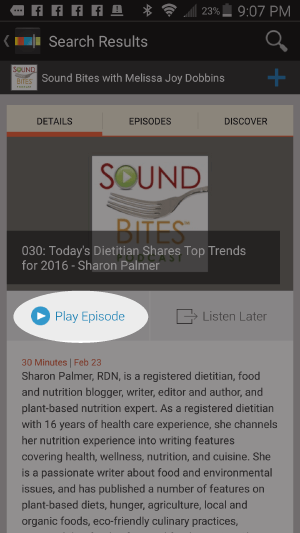
Listen on Stitcher (Android)
Install the Stitcher App
1. Search for “sound bites with melissa joy dobbins” 2. Choose Play Current Episode or Add to Playlist
Choose “Play Episode”
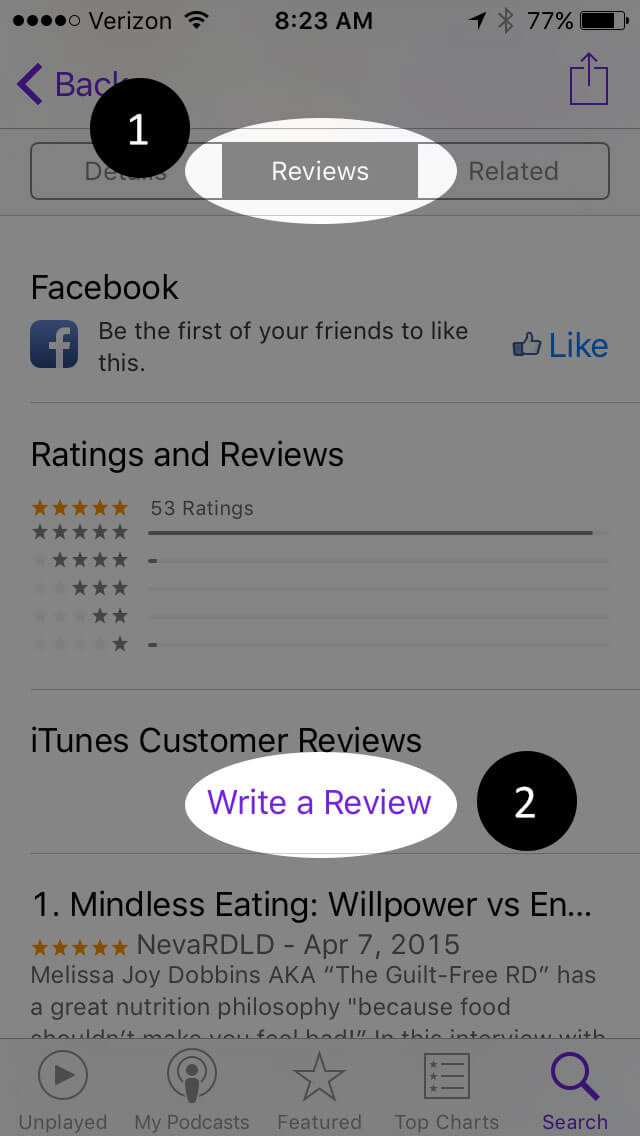
Subscribe & Review on iPhone
Open the “Podcast” app on your iPhone
Search for “Sound bites with melissa joy dobbins”
Open the podcast and click “Subscribe” and your done!
Write a Review
Click “Reviews”, then “Write a Review”.
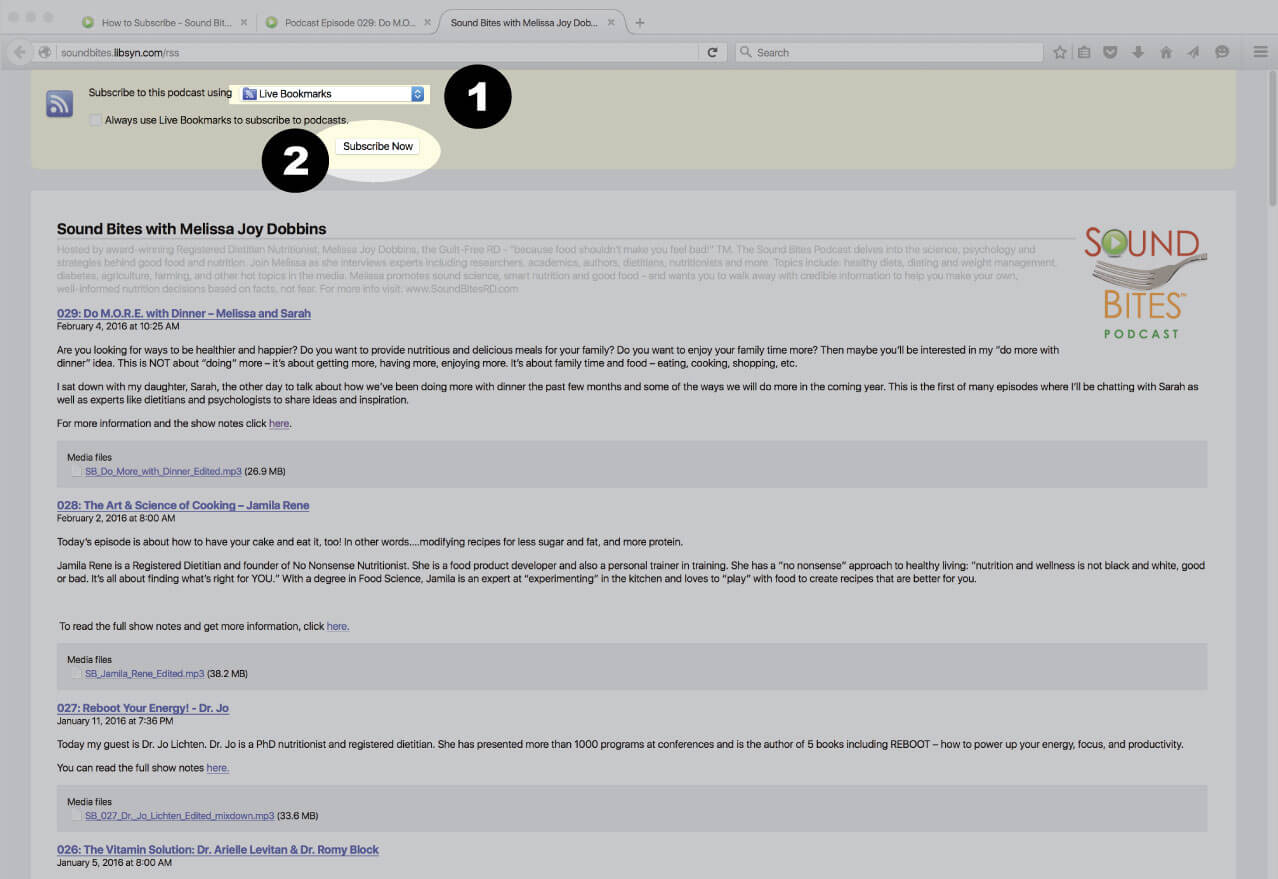
Subscribe via RSS Feed
Navigate to any podcast player . Click on the RSS feed icon.
Click on the RSS feed icon.
Click on RSS Feed
Choose which application you would like to use to receive the RSS feed
Click “Subscribe Now”
Confirm settings and subscribe.
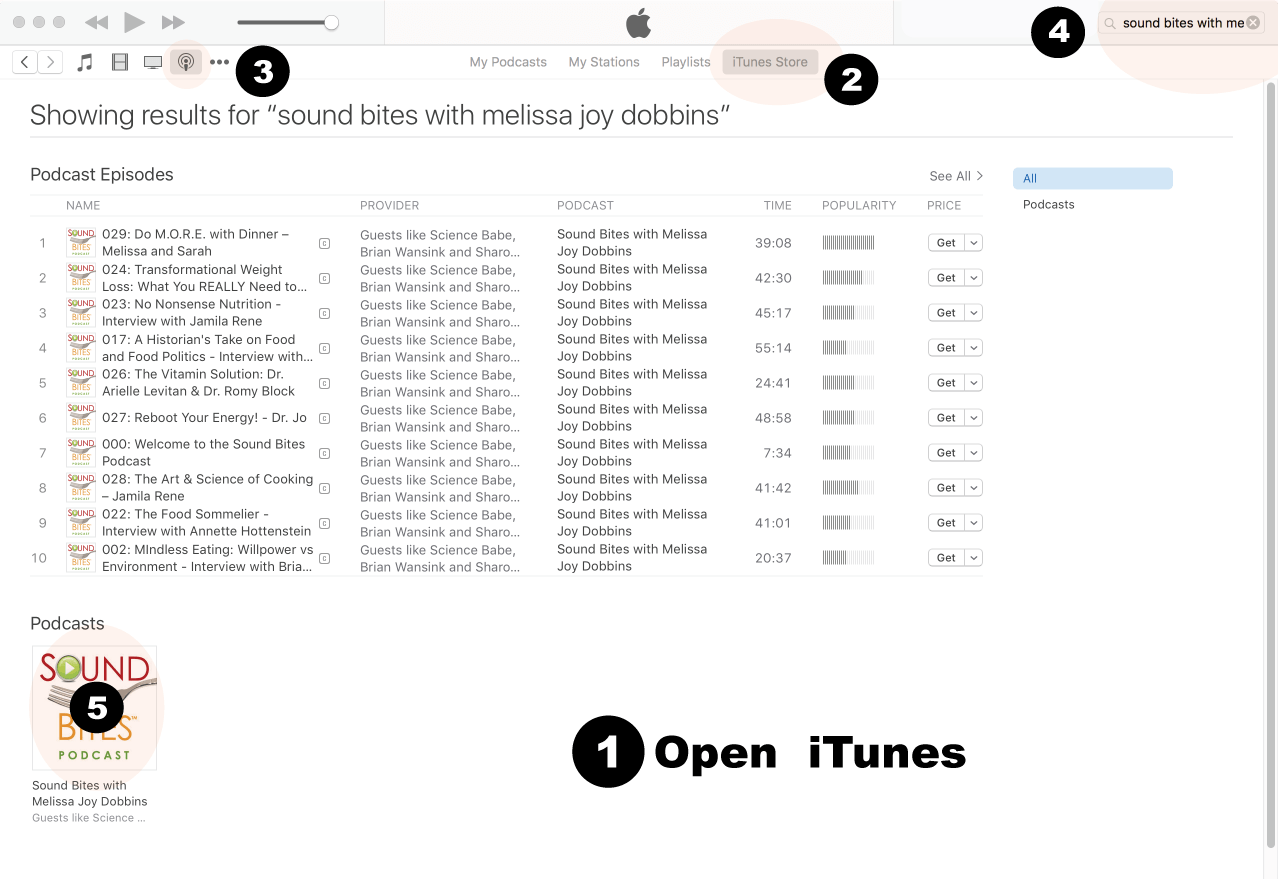
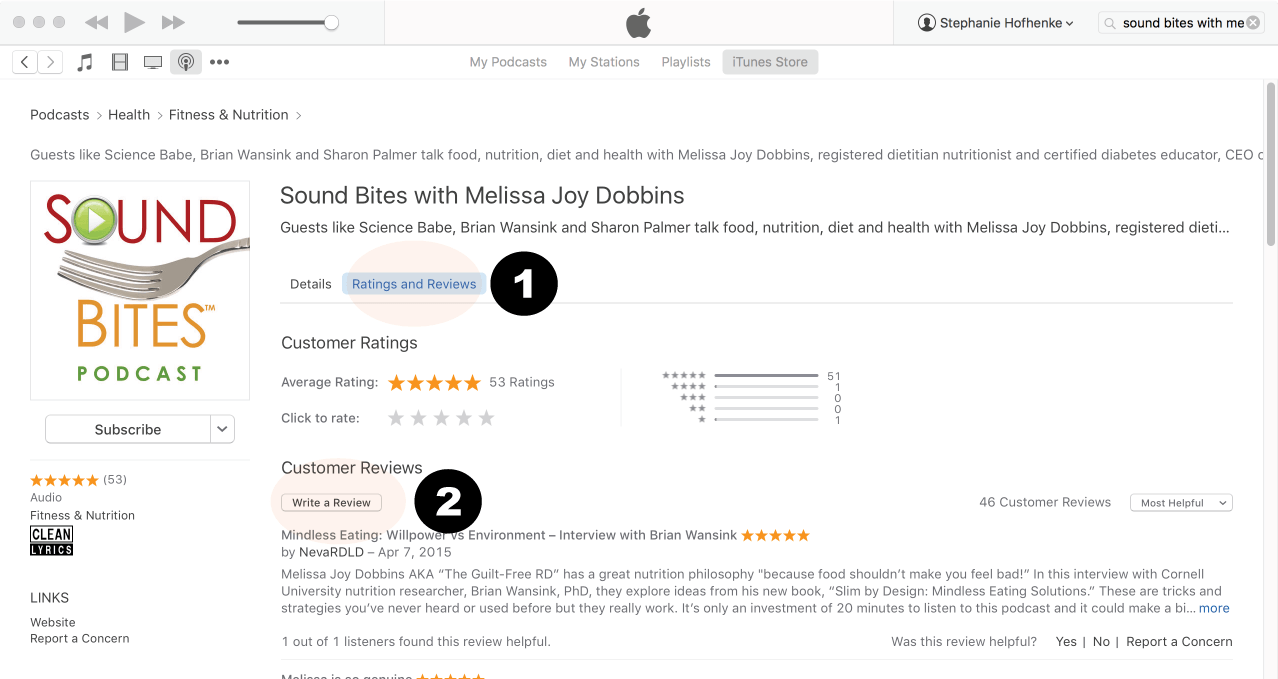
How to Review in iTunes
Open iTunes desktop application
Click iTunes Store
Click on Podcasts
Search for “Sound bites with Melissa Joy Dobbins”
Click on podcast image
Search for Sound Bites podcast in iTunes
Click Ratings & Reivews
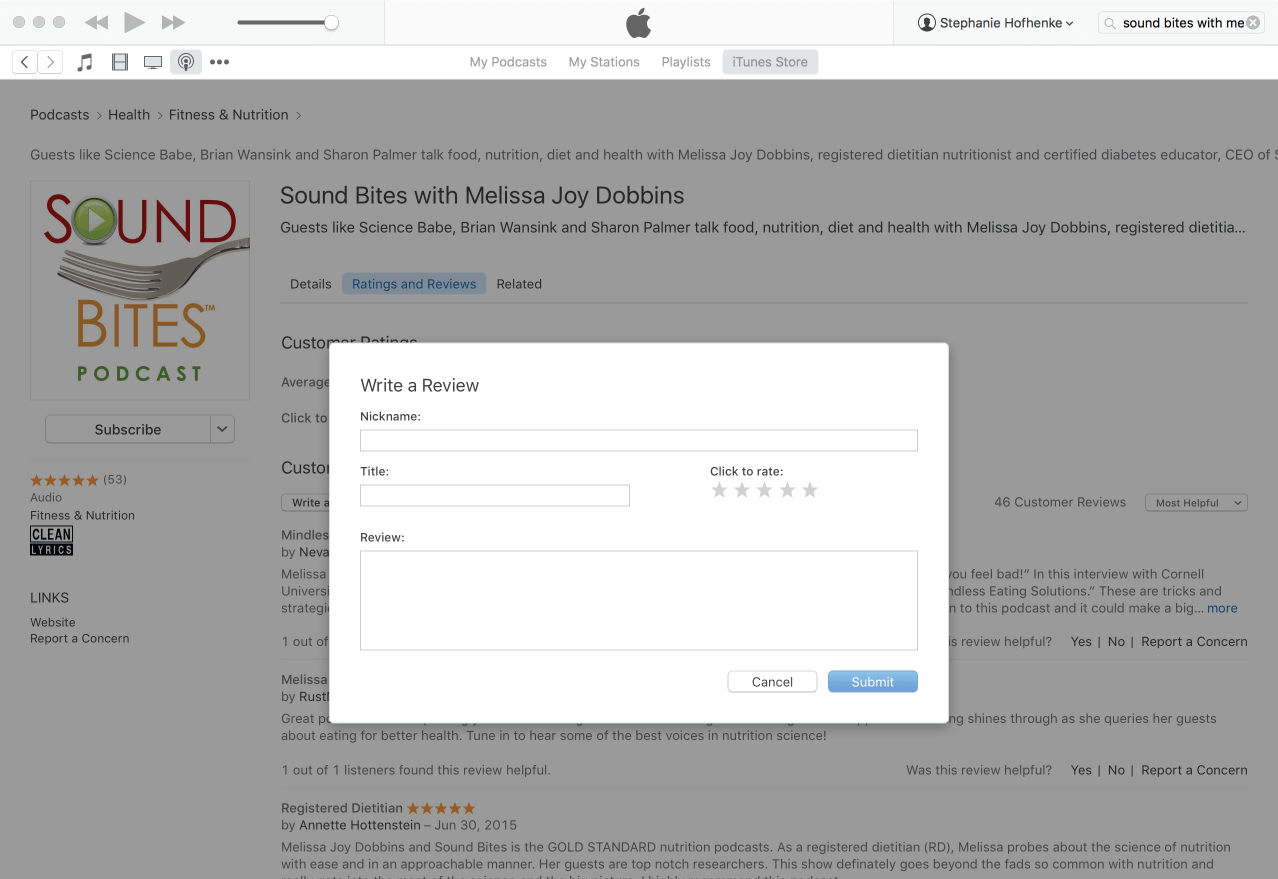
Click Write a Review
View reviews and write your own review.
Write your review…. Thank you!
Write your review!
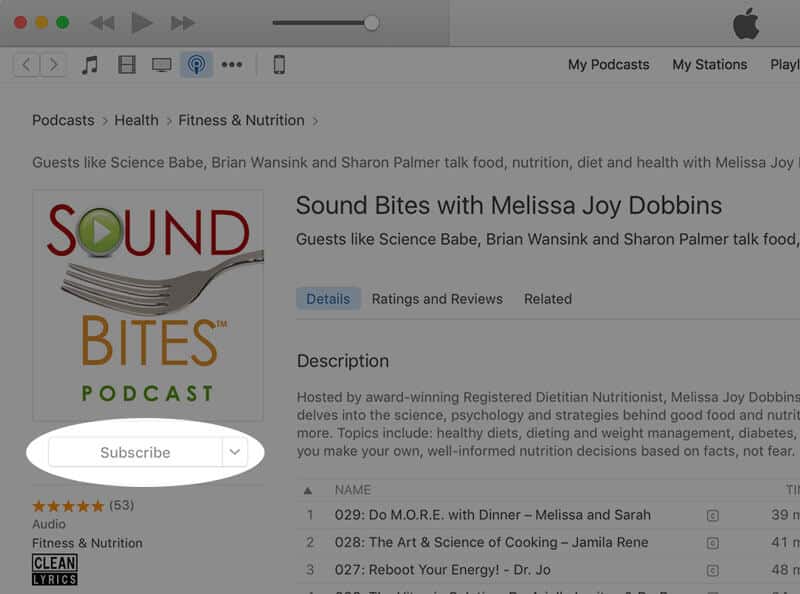
How to subscribe via iTunes
Click here to view the Sound Bites Podcastin iTunes, then click the blue “View in iTunes” button. This will open your iTunes application directly to Sound Bites Podcast. Click the “Subscribe” button, and your done!