Celebrating over 1 Million Downloads and 50,000 Free CEUs on the Sound Bites® Podcast | NEW: Get 1 years’ worth of CEUs with the new 15-CEU Podcast Course
What’s In Store: Shopping on a Budget and The Shift Toward Health & Well-Being
Inflation has caused the price of all consumer goods – from gasoline to apparel – to increase. According to the May 2022 Consumer Price Index Summary, grocery prices are up 11.9%, the largest year-over-year increase since 1979. A number of factors go into food prices including supply chain logistics and ingredients and packaging availability. One major factor is consumer demand for groceries, which has remained high since the beginning of the pandemic. Additional challenges impacting food prices include a shortage of truck drivers needed to deliver products to grocery stores, supply chain bottlenecks such as flooding and labor shortages, and a rise in the cost of raw materials—like corn, wheat, soybeans, vegetables oils and even packaging like aluminum.
Tune in to this episode to learn about:
the many factors contributing to rising food prices
trends in shopping habits
tips for shopping healthy on a budget
what consumers and retailers can do to decrease food waste
meal planning and preparation resources
how retailers are responding to consumer interest in health and wellness
the role of the dietitian in the grocery store setting
Krystal Register, MS, RDN, LDN
Krystal is the Senior Director of Health and Well-Being for FMI – The Food Industry Association. Before joining FMI, Krystal served the food industry for 12 years at Wegmans where she developed and executed company-wide wellness programs, health messaging, employee training and in-store promotions. Prior to that Krystal studied environmental and nutrition science studies at the College of William and Mary and James Madison University, with experience in both clinical nutrition and personal coaching. At FMI, Krystal leads nutrition, health and well-being programs and activities and serves as the issue expert on all health and well-being and nutrition policy, operations, and communication issues for FMI members.
[00:00:00] Melissa: Hello. And welcome back to the sound bites podcast. Today’s episode is about rising food costs, grocery shopping trends and insights, and how to shop on a budget to get more bang for your buck. My guest today is Krystal Register. She’s a registered dietitian and senior director of health and wellbeing for FMI – the food industry association, where she leads nutrition, health, and wellbeing programs and activities, and serves as the issues expert on all health and wellbeing and nutrition policy, operations, and communication issues for FMI members. Prior to joining FMI, Krystal worked at Wegmans supermarkets for 12 years where she developed and executed company-wide wellness programs, health messaging, employee training, and in-store promotions.
Welcome to the show, Krystal. Thank you. It’s great to be here. I’m so happy to have you on this show. We first met about 10 years ago when I did a media and issues training for the team of dietitians at Wegmans, under the leadership of Jane Andrews. And that’s where we first met. And I was so excited to see that you are joining FMI.
Now, how long have you been there now?
[00:01:14] Krystal: I started shortly after our pandemic shift, so I started June 1st, 2020. So just crossed my two year mark at FMI.
[00:01:24] Melissa: Wow. I didn’t realize it was during that crazy time. Oh my gosh. Yeah. I thought it was more recent, but yeah, that’s wonderful. Now, before we start talking all things grocery shopping and food prices.
Tell us more about your background. How you initially got interested in nutrition in the first place.
[00:01:44] Krystal: I love this question. So kind of always grew up as maybe an classify me as an athletic math nerd with a love of science. And I just always felt better when I was taking really good care of myself, if that makes sense, eating right, running around drinking water and sleeping well.
And I attribute this yearning I always had to get into the healthcare field to my mom. She was a registered nurse and truly the model of healthcare professional, just dedicated to caring. She had knack for education and teaching. But this true attention to detail and I wasn’t quite sure where I wanted to go in the healthcare field.
So as I was completing undergraduate studies in environmental science, because secretly I loved just being outside and exploring outside. So it was perfect fit for me to complete my pre-med requirements. So had this great intention to go to medical school for preventive medicine. Which I quickly found doesn’t quite exist in the way our healthcare system was set up.
Mm. So I had this passion to just help people stay healthy, prevent illness and manage disease. And I thought maybe instead of this preventive medicine doctor calling I’ll shift gears and follow in my mom’s footsteps and become a nurse. So one of the first prerequisite classes for nursing school I took was an introductory nutrition course taught by a registered dietitian.
And I was just absolutely sold. Wow. So off to grad school, I went followed by the internship in the hospital, really found this love in this profession as a dietitian, health promoter, disease preventer, caring healthcare professional. So and I hopped around from different things, anything from clinical to just one-on-one counseling and coaching.
And I truly feel like I landed in this unexpected space with supermarket and food. So roundabout way, I got myself into this amazing arena of food, retail, registered dietitian, and now across the whole food industry.
[00:03:48] Melissa: Oh, how exciting. I did not know that about your, your background with your mom. I always love hearing people’s stories and that is just so fascinating and I’m just totally impressed that one of the first classes in the nursing program was about nutrition.
Yes. Taught by a dietitian. I’m just really excited to hear that. So as you know I’m a former supermarket dietitian and it was interesting because my first job was clinical. My second job was outpatient, but it was based in a hospital setting. I went out into the community. I did store tours.
That was my first day on the job was when I did my first TV segment. And it was really my favorite job. I loved it because I got to do so many different things. Including covering clinical on holidays and weekends trying to keep those skills up. But when I interviewed for my supermarket job, I thought, gosh, I don’t know the first thing about this, but when I saw all the job duties, it was exactly everything that I had been doing in my outpatient community role.
And it turned out to be that only, I like to say, like on steroids or on like a super dose of caffeine because wow, Supermarket dietitians bow to you because I could only survive about three years there because I, I pulled all nighters for that job. I mean, I worked so hard in that job, just trying to prove the role and the purpose and the ROI of a dietitian in that setting and just, it’s so important.
And it’s so exciting. And this was early two thousands when I was a supermarket dietitian. So I’m curious know, you said you kind of popped around a little bit in different types of roles. Was it something specific or was it just sort of accidental that you did end up in the retail environment?
[00:05:29] Krystal: That’s a great question. And you mentioned Jane Andrews from Wegmans, it was accidental and I attribute this and this is for anyone out there, regardless of what profession you’re in. I can attribute it to a volunteer position I had with my professional association. So as a hardcore volunteer with my local affiliate of the academy of nutrition and dietetics, I was working on helping with the annual meeting and we just wanted some bags to put your registration information in. Wow. And I was the one to contact Wegmans and sure enough, Jane Andrews from Wegmans said, let’s get you the bags you need for your conference of dietitians in the state of Virginia, but I’m gonna also come to your event if that’s okay.
So I met Jane one on one in person, and I think we see the same thing happening across the country. Now, when dietitians meet or interact with a dietitian that’s in that supermarket or retail setting, they have that aha moment, like, okay. Tell me more about what you do and, and your role in the supermarket.
So I think it was almost a year after I met Jane. I was counseling with my own little practice, one on one, and I got a phone call out of the blue, unexpected from her and she said, I have an opportunity for you if you’re interested. So. My second tag along there, piece of advice would be any opportunity that comes your way, even if it feels a little, little out of the scope of what you’re used to –
It’s always fun to step through that door when it opens up. That’s exactly how it happens. So, oh gosh, accidentally.
[00:07:08] Melissa: I love that. And Jane is just so wonderful. Absolutely. I believe she’s retired now. She is hopefully enjoying retirement and just a pioneer and just an absolute lovely person. Absolutely.
And I will add onto your point about volunteer because people ask me how I got involved in the media and everything, and really it was part of my job as a supermarket dietitian and then as a dairy council dietitian. However, I decided to give back to my state association by being a state media rep.
People were asking me to run for president and stuff. I’m like, no, no, no, no, no, no, no. That’s not me. I can’t do that. That’s that’s crazy. But I said, but you know, I have these skills I can serve as a state media rep. Fine. Well then when a position came open as a volunteer academy spokesperson, I thought, well, okay that happens once every eight years or so in Chicago, they, they used to kind of go by location.
And so I said, okay, I’ll apply. And that really did open a lot of doors for me. And I’d already had my national connection with supermarket dietitians because I worked with dietitians across the us. And then the same thing with the dairy council, I was a national dairy council spokesperson, but yeah, being an academy spokesperson again, just did open a lot of different doors and, and, and met a lot of different people.
I wholeheartedly agree with your advice and thank you for sharing that.
[00:08:34] Krystal: When I, I especially love that because I was the Virginia state media rep because someone suggested it to me on a volunteer basis, I was a little hesitant. I said, I don’t have a communications background. And everyone said, yeah, but you can speak to this pretty well.
So we’d like for you to give it a shot. And that’s one thing that Jane actually saw in action when we were at that conference, I got pulled away to do a radio interview. Mm. And then I think she had that aha moment, like, okay, we got an interested dietictan who went have some media skills, which is actually pretty important in the supermarket retail space too.
So I love that we have that connection too, starting as state media reps.
[00:09:15] Melissa: That’s great. And, and hopefully any dietitians listening will, this will resonate with them too, because it really. It does matter to go beyond your comfort zone a little bit and to it and it’s wonderful that we’re humble and we’re like, well, I don’t, I don’t really know how to do that, but be open to learning and taking those opportunities is really important.
Absolutely. So back to the topic at hand…. I’ve been thinking more and more as everybody has lately about how our food prices are really rising. Prior to the pandemic, we always wanted to shop healthy on a budget. That’s one of my favorite topics that I still talk to the media about – just always getting more nutrition and value for the money you spend at the grocery store, but we could always still say like we’re lucky as Americans, that the portion of our income that we spend on food is quite small.
Then the pandemic hits and we go from having all of this availability and this abundance to, oh my gosh, there’s empty shelves. People are hoarding. There’s supply chain issues, which is not anything that was on most people’s radar prior to the pandemic. In addition, I mean, food insecurity is a huge issue, but we started seeing some improvements in that.
And then the pandemic hits and that’s all thrown out the window because it’s even more of an issue now. So I know that we’re gonna focus mostly on rising food prices today, but I don’t think we can have that conversation without talking about how we got here and all of the changes that happened during the pandemic.
So why don’t we start back there a little bit, because I know that in the retail setting there’s some, some unique things that happened. And that’s your role. And actually I’m gonna back up a little bit and say, tell us a little bit more about FMI and your role specifically, and then we’ll dive into this.
[00:11:13] Krystal: Sure. So at FMI, we are very member driven and our members span across the entire food industry to include retailers from as large as you can think to as small as you can think. So from the large national chains to the small independent operators. Okay. But then also we include the product supplier manufacturers.
And again, a lot of those large companies that you, you would recognize to even smaller ones. And really then our, our mission is to support and serve our members across the industry. And even the I, I love to point this out cause I’m very visual and I love drawing, but our FMI logo has three, slightly different colored green arcs around it.
And each one represents one of our three main missions and that’s to advocate for our members, to educate and to collaborate with our members. So on the advocate side, we band together and we really listen to our members on what, what they need. A lot, a lot of that has come to surface through the course of COVID and shifting priorities, whether it’s been helping accelerate pharmacy services that are available at retail, or maybe we provide comment on policy options to the federal agencies when, when we get the chance, but we do that collectively. So in order to advocate for our members, in terms of educating, we do a lot of research, which we’ll touch on a lot of that today, but both from the consumer side and then also from the industry side, so that and helping folks tap into the best resources and then collaboration is key, no matter what we’re doing.
So that advocate educate and collaborate. We work together and specific for me, I have a health and wellbeing council made up of all those members plus community collaborators, because the voice of some of our other associations or it’s, it’s vital to me to be listening to everyone as we embark on our health and wellbeing initiatives, and then we have a health and wellbeing committee, that’s a board level committee as.
[00:13:15] Melissa: Okay. So instead of all of these grocery stores, retail outlets, having to sort of figure it out on their own, they can look to you for support and resources.
[00:13:25] Krystal: Absolutely. Whether it’s a very small we, sometimes we get that smallest request to, can you help us find out X, Y, or Z to, Hey, we’re looking to embark on new adventure.
Do you have strategic suggestions or just like I say, collaborating on some of these bigger issues around policy.
[00:13:44] Melissa: Great. Excellent. Okay. So now back to my diatribe that I had about the rising food prices, the shifts in the pandemic and where we saw changes that you’re gonna share with us, including food insecurity, food access, food prices, and just trends and insights.
[00:14:03] Krystal: Yeah. So maybe if we start with some kind of an overview of some of the trends we saw through the pandemic in like a really, really brief way, in addition to those that we, we know, because we felt them personally, right. We saw a change in the supply chain, as you mentioned. Did your neighbors ever talk about the supply chain before?
No. No. And everyone was talking about the supply chain, right? So not just shortages, but then we did see some prices going up, but also at the same time, we were at the beginning of the pandemic, we were all focused on what we could get at the grocery store because we had no real other options when restaurants shut down.
And then as kind of things came back, we still saw some trends towards people were still eating a little bit more at home and relying on the grocery store. I find it interesting that some of the consumer shift that also happened during the pandemic shifted to this focus on health too, which was very interesting for so many different reasons.
So consumers in our trends research that we do, so we follow consumer trends and through the pandemic this is used to be an annual report at FMI for the past 40 years through the pandemic. We were looking at it on a, a monthly sometimes more, more frequent basis, even because everything was changing so quickly.
Truly what consumers were saying was they really were prioritizing improving their nutrition and their overall health looking specifically at prevention and self care on what can I do to keep myself healthy and well. So at the same time we were seeing their behaviors were shifting a little bit.
So. They shifted towards healthier eating. And most people we know there was most people admitted there’s room for improvement, but I think I actually might be eating a little healthier. I think that was music to the ears of dietitians, because sometimes the most difficult part of getting a nutrition or health and wellbeing message out there is that if somebody’s not ready to listen, they’re not ready to listen and they’re I gonna listen.
So there’s there was definitely the opportunity to have a captive audience. So then from the retailer side, though, we did see this shift in a sharp growth in programming related to health and wellbeing. So not only were we seeing this on that consumer side, retailers were reporting that they either significantly or moderately increased their health and wellbeing programs.
And that was for employees and for customers, which is really interesting. And they’re really prioritizing these programs. And then we saw also that in general from the industry, that industry leaders were prioritizing health and wellbeing as part of the business, because they knew that this was what customers are looking for and they knew that there’d be that positive impact of leveraging food to manage or avoid health issues and really wanted to see how can I explore that space, the health and wellbeing space.
So interesting trends through the pandemic that should this shift of our focus on health. And then we can get into what we’re seeing now. This continued increase in cost.
[00:17:04] Melissa: Yeah. Yeah. You mentioned this kind of music to dietitian’s ears, that people are really focusing more on health and, and behaviors as well.
Not just their focus, but their making behavior change and things like cooking more at home. And I know in one of your reports that we’re gonna touch on, I think it’s the power of health and wellbeing in the food industry report that FMI did in 2021. 41% of the respondents said that they expect that they will prepare meals at home even more than before the pandemic and it to kind of continue that.
And I’ve seen other consumer insights that there were some positive changes that people at least said, they thought that they would continue like cooking more at home exercising more. Right. And things like that. So that’s good news. Right. And yeah. Kind of taking that opportunity to strike while the iron’s hot or whatever.
[00:17:57] Krystal: And that’s it. We like to frame when, when we get that consumer research and insights, we like to frame it as well. Here’s an opportunity and what we’re really hearing. And I, I know I’m the same way. If I wanna continue to be cooking more and eating more at home, I might need a little extra inspiration and encouragement.
And that’s the, that’s the opportunity we toss back to retailers and product suppliers and manufacturers like, okay, we’re, we’re all in this together. Now let’s band together. And. Consumers continue to find easy meal solutions and snack ideas. Everybody’s looking for this all day, every day now.
[00:18:35] Melissa: Yeah. And, and I know we’re gonna touch on this more later, as we talk about different programs that retailers are doing and everything, but I think it would be helpful for some of our listeners who maybe aren’t as familiar. They’ve just go to the store and they’re like, well, I see the pharmacy. I don’t really see it at dietitian presence in my store.
Can we just kinda run down? There’s a lot of things that can be a part of these programming, meal solutions, cooking demos, just where things are displayed in store and things like that. Right. So if you could just kind of give us a kind of an overview for those who are like, oh, I didn’t realize that was kind of a thing.
Sure. And, and sort of like subliminally they’ll. Yeah. Be like, oh yeah, I’ve seen that.
[00:19:16] Krystal: This, I think this will latch right into we have an overarching kind of theme that grocery stores really have become a destination for health and wellbeing. And a lot of that is because of these health and wellbeing programs that I mentioned, but really there’s this unique opportunity in that food retail setting for registered dietitians and pharmacists to really help meet these consumer demands and improve public health.
And I always like to level set that when we talk about the grocery store, as that destination for health and wellbeing, it really does take everyone prior to something arriving in the grocery store, right? So that’s our product suppliers and manufacturers and, and our community collaborators kind of getting everything there.
But really when you get right in the aisles, it’s the registered dietitians who are equipped to build the trust and loyalty by taking this complex world of nutrition. Right. And creating really sound advice and practical guidance right in the aisles. Now, like you said, I don’t walk into my grocery store and see a dietitian standing there in the aisles to help me.
Right. And especially through the pandemic, we did see that actually prior to the pandemic, we did see grocery store registered dietitians in the aisle, doing some typical in-store interactions. So things like small store tours, maybe even disease specific, maybe we’re gonna do a heart healthy store tour, or maybe we’re gonna do a diabetes cooking class.
And we’re in person doing these things. Maybe even some one-on-one counseling right at the in-store level, some even involvement with the combination of pharmacy dietitians doing health screenings. So now there always was some virtual component going on, but really what the pandemic did was huge uptick right in the virtual expansion of services. So take those classes. From in store now to a video class and the audience can just explode, right? You can go from small numbers to large numbers of people in these video classes. It could be video store tours, video cooking demos, anything around disease management, and a lot of programming for children too.
And then take that one on one typical in person to telenutrition. So that whole connecting virtually one on one with a dietitian, then we get into medical nutrition therapy. And just really the piece that you mentioned, what’s going on behind the scenes. What are dietitians doing behind the scenes, everything that’s in that path to purchase space.
So maybe it’s accurate labeling maybe now with everything going to building a shopping list online is that nutrition information that’s in your app or online accurate as well. And a lot of times there’s dietitians working behind the scenes on that. And even to make sure that signage is accurate a lot with allergies, intolerances, and government policies, like I think a good example there is there’s a definition for gluten free. Right. We need to be following that if there’s a gluten free label. And a lot of times there’s a dietitian ensuring that. And then the other piece right now is, is media in general, right? So just media outreach is digital outreach. Whether it’s email, content, blog posts, social media, a lot of times I think consumers – it’s kind of hidden, right.
But they can tap into so much great information that’s being provided right through the grocery store by some credible experts.
[00:22:33] Melissa: Thank you. So as we continue our conversation, I definitely want you to share any consumer insights and trends, shopping habits or so on. Whether it was pre pandemic during the pandemic, what we’re seeing now, but let’s get right to these rising food prices.
I know it’s not simple. I know it’s complex. And I, and I know everybody out there kind of gets that, but I’d love to hear some more specifics about what all is going on there. Yeah. Like you said, before, it even gets to the store there’s stuff going on. So give us a rundown on rising food prices.
[00:23:08] Krystal: So the easiest part to see is that supply chain shift, right?
So we’ve all seen that the global supply chain issues that really are impacting how we get food to the store shelves. Then there’s this inflationary, economic pressures that, that really have so much to do with so many different things that can be related to production costs or distribution costs.
There’s labor challenges everywhere. And I think we all see that going on, too, high turnover. There’s difficulty recruiting, new talent. And then of course there are the challenges unexpected that are the result of this conflict in Ukraine. We we’ll probably continue to see more of that. Some of the items that are, are being impacted because of the global supply chain reliance on things that typically have come out of of that.
So just a combination of so many different things, and we have some good resources that really help explain this, I think, in a multifaceted way. But really another contributing factor is what we said. It’s the consumer demand for groceries as well. And we know now the average weekly grocery spending has gone up.
So currently it’s at $148 a week, which is up 4% from February of 2021. Here’s what happened during the pandemic. Started the first first grab we have is at about $121 peaked at $161. Now we’re at $148, which actually is an increase, as I said, is 4% from 2021. So we’re, we’re seeing this average weekly spending up.
And then as I mentioned, everything, impacting food prices from the shortage of the truck drivers to the supply chain bottlenecks, we’ve all seen these images of cargo ships stuck, where they are, flooding – we see weather and again, the labor shortages costs of raw materials too. It’s interesting.
And even packaging. So sometimes it’s the things we don’t think about that may be affecting something simple. And we do have a really nice infographic that shows a peanut butter and jelly sandwich and everything that goes into the peanut butter and jelly sandwich. Really really helps visualize some of this.
[00:25:34] Melissa: Yes. And I, I have that and I’ll put that on my show notes@soundbitesrd.com for people to look at. Oh great. But if you wanted to mention a couple of the aspects, that would be great.
[00:25:44] Krystal: Sure. It really does get out this from weather to shipping, to labor, what everything I was talking about. It’s like, these are everyday staples, right.
That are being affected. So if we look at just the peanut butter transportation issues, peanuts are transported domestically, and it’s been delayed by supply chain disruptions and the labor shortages too. So that increased the cost of just getting the peanut butter across the country. Right? And then the vegetable oils that are used to make peanut butter have suffered from shortages and poor harvests.
And then the 70% increase in soybean oils going to be affecting that, just that peanut butter component. And then we get into the bread there’s packaging, whether it’s the supply of cardboard boxes or just this increased demand for online shopping has also caused some higher cost for freight raw materials.
And the box shortage is just something we don’t think about, but it’s made it difficult to ship and stock bread in some parts of the country. And, and then of course the workforce challenges are right in the same graphic. And then in the jam there’s a Citric acid as a preservative that keeps jarred items, shelf stable, and it’s in short supply amid the soaring demand and global logistics disruption and, and sugar itself.
So believe it or not, domestic sugar prices are at a 10 year high. And that’s that fueled by the lack of. Domestic raw sugar cane supply combined again with the transportation and labor challenges. So it’s just fascinating to see how some of our favorite products cost more, but it it’s so complex when we look at something that seems so simple, like why isn’t my peanut butter on the shelf, right?
[00:27:18] Melissa: We take this simple PBJ, right. And peel back the slice of bread and you get all of this complexity. Well, thank you for, for sharing that. What do you see from the retail’s perspective, from an FMI perspective? Any projections on when we’re gonna start to see some of this improving and the prices stabilizing or are coming back down?
[00:27:43] Krystal: Yeah. And that’s, that’s a magic crystal ball that we just don’t have. We it’s, it’s so difficult to predict because there are so many different factors. I think one note to make though, is that shoppers recognize that there’s a lot of reasons for elevated spending and the costs. So they’re starting to recognize that, but then it’s time to look at well, what are they most concerned about maybe and what are they doing about it, right.
I’d be happy to share some of that. If you’d like.
[00:28:15] Melissa: Yes, I was going to ask you, I know you’ve got some great consumer insights on how shoppers are coping with these higher food prices and what sort of changes they’re making and, and what kind of behaviors you’re seeing.
[00:28:29] Krystal: Yeah. So we know that the majority of shoppers really are worried.
And that’s when I say majority that’s 86% of the consumers that are, are responding to our surveys. So 86% of shoppers are worried about rising food prices and they are making some behavior changes, including things that like looking for deals, that’s a, a big one. So 59% are looking for deals and 58% are making substitutions or product changes.
And I know I’ve even done that with, I can’t find something or if the price has gone up significantly on an otherwise standard item, look for substitution. 48%. That’s almost half are changing where or how they buy their groceries. And then we do see, we do a lot with tracking private brands and 35% of customers now say they’re buying more private brands.
So that would be that store brand item that quite often is high quality, just a better price for a lot of sometimes these supply chain relationships are a little bit more intimate, so things may be easier to get if it’s a store brand, so may be easier for a retailer to put those items on the shelf than.
I I’m here to say you encourage consumers to try the store brand.
[00:29:42] Melissa: Absolutely. I, I had not realized that that would be a, a benefit, but I’m, I’m always for the store brands. And I always knew they were a value, but boy, they might be more available and who doesn’t like get a little tweaked, if you find a product that you really enjoy and then all of a sudden, I mean, this is a way pre pandemic, like, right. Wait, I loved this garlic flavored shredded cheese by a Sargento, not throw them under the bus, but it’s a, this is a real thing. And then all of a sudden I couldn’t get it anymore. And I was, but I loved that product. Right. Obviously we’re seeing that more and more now, but yeah, definitely encourage people to try the store brands.
[00:30:19] Krystal: Then there’s some more specifics there. So some of the other solutions that shoppers are finding, not just looking for more deals, but maybe only buying something when it’s on sale or a deal. That’s about a third of consumers are saying that. People just say in general, they’re maybe not buying as much fresh in terms of meat or seafood, so buying more frozen meat or seafood.
So less of the fresh and more of the frozen – kind of cutting back on some of those places where maybe historically you purchased only organic and recognizing that that would be a cost saving or maybe just not buying as much fresh produce also. And interestingly, this is a note through a couple different of these consumer surveys, we’ve found that customers understand that when they shop online are for delivery. Quite often, the prices are higher because of delivery fees or sometimes even every item costs slightly more. So some consumers are saying they’re buying when I say they shift kind of the, how and the where they’re buying food, this slight shift in buying more in person.
Hmm. So I, I said, tip, I wouldn’t say like, just make sure you’re aware of the extra fees that are included with delivery or that online purchase. And then of course, like I mentioned, the buying more store brands, but just in general, as you mentioned, like changing brands, even if it’s not to a store brand changing brands.
And sometimes that’s hard to do if we have our tried and true favorites or if your family is hooked on one brand of something and you can’t find it, it’s really difficult. But we are seeing these actual behavior changes at the point of purchase by shoppers. So they’re really looking for solutions.
[00:32:01] Melissa: Yeah. That’s interesting. And in addition to what you’re seeing people doing, do you have some tips? Like I said, eating healthy on a budget is one of my favorite topics. And so we know some of the tried and trues, like try to buy in bulk. I love how you mention that people are shifting away from fresh a little bit and relying more on pantry and freezer items, whether it’s produce or meat, because we’ve always said it’s just as nutritious and not only is it more cost effective, but it can also help decrease food waste.
But in addition to what you’re seeing people doing just from a retail dietitian standpoint and being more up to date on some tips than my old tried and true eating healthy on a budget. What would you suggest that people do that they might not be thinking of?
[00:32:48] Krystal: Sure. A few things. So most grocers have online and in store tools to help shoppers.
Plan meals in advance. So that may help cut down on food waste. It may help budget a little bit better. So that may be like I mentioned, building a shopping list in an app. So if you’re building your list in the app, quite often, you can see the cost of the foods you’re building. And that’s where too, to kind of balance, and I challenge to test if it’s costing the same, if you go to the store or if you’re having it delivered, just make sure there’s, you’re noting the extra fees involved there, but really using those tools. So within some of those retailer apps, there are digital coupons provided. So grocery loyalty programs in the apps also provide shoppers with alerts on sales and deals and these digital coupons. So just make sure you’re paying attention to what’s available in the digital space, if you will.
[00:33:43] Melissa: My store has that and I’m not great at using it yet. And funny, my 83 year old mother-in-law is trying to teach me how to do it. There you go. And, but I gotta get on that more.
[00:33:53] Krystal: Yeah. Sometimes we see, even if consumers, like you are latched into the app in one way, shape or form, maybe you’re not latched in yet to the cost savings part. Right. But getting, get those digital coupons and make sure that they’re associated with your personal account too. So, and then just knowing the prices of items before you go to the store, using some of these tools will help with meal planning and budgeting and making the list that really does fit your budget. And then this again, I’ll put a plug in for the food retail, registered dietitians quite often have some tips and tricks up their sleeves, whether that, that may be playing out online in like an article or a blog post, or there may be a nutrition in health part of the grocer’s website that would be sharing some of these registered dietitian tips.
And a lot of those are budget friendly tips but also just suggesting different meal ideas and recipes and ingredients and that substitution part. So there may be there’s something now that you’re, you’re substituting maybe you’ve never used a frozen version of something that you typically buy fresh.
Sometimes you can find good tips from those retail registered dietitians. And then again I mentioned the store brand options just quite often, they taste just as good and they can offer more products. Sometimes they even, there’s a higher quality because it’s, it may be a, a retailer investing in putting their own name on a product. So they’re gonna make sure that it’s great tasting and, and convenient and affordable too. So some of those are lower prices quite often, compared to the brand name products. So it takes a little bit of research maybe, but really this budget friendly idea. And then the only other thing I’ll note is tapping into the USDA has great resources associated with myplate.
So just this past fall, they came out with a shop simple app. And it really is a great tool and it will expand. So they started pretty simple. So there’s five different food groups in my plate. What they did with each of those food groups was select. The five, and this is the registered dietitians working at USDA the, what they found to be in general, the five most nutritious affordable foods in each of those food categories.
And then it’s can help build a shopping list, but also in this app. And it’s a web based app. So it’s designed that you don’t have to log in. You don’t have to pay for anything. You don’t have to remember a password or anything. It’s, it’s literally like going to a website, but it functions like an app.
So really designed to help Americans save money while shopping for healthy food choices. But once you have these items there, there’s also tips on how to prep these foods and there’s recipes and, and meal ideas. So new ideas for cooking, just a way to add variety, but really keep some of the low cost high nutrition items right in your shopping cart too.
So that’s the shop simple app is something I would highly recommend. And I think we’ll see more to come as that expands.
[00:36:53] Melissa: Okay, great. I’m gonna check that out. Yeah. I mean, we saw quite a bit during the pandemic when people had to shop their pantry and make substitutions. Right. And even though I’m a dietitian and I know like recipe modification, I mean, literally when it comes to, can I use a red onion instead of a white onion in this I’m like completely ignorant.
Right. And had to do some trial and error or experimentation on my own. Yeah. But yeah, just add on to what you’re saying. And, and again, I love that rely on more canned, frozen, packaged foods to round out your fresh purchases. And there, like you said, those low cost, high nutrient foods, things like beans, whether it’s dried beans or canned beans, eggs, canned fish, the store brands again, that bears repeating. Yep. Buying in bulk, if you can, and sharing with others, if it’s too much for you to use before things go bad. And just the fact that during the pandemic, even though food prices were maybe into fluctuation, they weren’t rising like they are now, but we, our, our grocery bills were going up because we weren’t going out dining out at all. Right. And so I think that is something that we can look to now is, okay, so the world’s opened up more and we are enjoying dining out, but one of the basic tenants to reduce your food costs is to cook more at home.
And I can’t move on from this topic without mentioning food waste, because one of the most important ways to get more money out of what you’re buying at the store is to make sure it doesn’t go bad. Right. And so that goes back to watching the amount of fresh items that you have, but also using up those leftovers and storing foods properly before they’re prepared and after.
Right. So I’ve got a podcast episode that I did on food waste. I think it was like actually pretty early on in the pandemic. I think we recorded it before the pandemic, but I’ll link to that in my show notes as well. Yeah. And any other related episodes that touch on these issues, but thank you for sharing those specifics and, and again just wanting to kind of see what are people doing? What could they do more?
But let’s shift our focus a little bit to the family meals movement. And also we had touched a little bit on the health and wellbeing opportunities that the programs and so on that are at the retail level. Which do you wanna talk about first?
[00:39:18] Krystal: Well, let’s talk about family meals, but first I just thought of two quick ideas that I started in my own home. And it probably was because I was focused on family meals and reducing kind of those number of trips to the grocery store and making sure that I wasn’t wasting any of the food that I bought. So the first one I do and it’s become a habit now and I never did this before the pandemic.
I have a little dry erase on the side of the refrigerator that any of my fresh meat poultry seafood items that I buy, I make a quick list with expiration dates and it really helps me prioritize what needs to be cooked first. Or if I don’t hit a date, it’s gotta go in the freezer. Yep. So just taking those and helps with family meal ideas.
The other thing I know, I always probably should have, could have would’ve done. But I’m really more focused on it now – when you get a bell pepper that looks like it’s not so great to eat fresh and crunchy with dip, I find myself just chopping up these vegetables and that can go for anything onions, sometimes I’m pre-cooking some things but, I’m making my own frozen and vegetables, if that makes sense. And again, it like helps me prepare the family meal, because sometimes it’s those ingredients that I’m, instead of them becoming waste, I’ve found a shortcut to help with a future family meal.
[00:40:38] Melissa: So as that fresh produce is kind of reaching that point where it needs to be eaten now, you actually chop it up and freeze it. Yeah. I love that.
[00:40:46] Krystal: So it’s like my own bag of frozen peppers and onions or my my own bag of maybe sometimes I will go ahead and cook something if it just seems like, okay, we’ve had enough broccoli this week. Yeah. I’ll roast it and freeze some to have, and it just makes things a little easier as we roll into family meals, which maybe is a good segue to talk about family meals.
[00:41:05] Melissa: Absolutely. And I’ll just also add, because it was kind of so obvious, but I became religious about it during the pandemic is I can’t live without my standing freezer. I mean, that sounds so ridiculous, but okay. I’m being dramatic.
I can live without it, but I love my standing freezer and things would go in. But getting them out was sort of like the hotel California. I’m not sure, like you can check in, but you don’t check out. So I’m religious now about putting masking tape on the item and saying what it is and what date it was frozen.
And that helps me remember, like, I’ve gotta use this up, or at least, okay. It’s a month old. It’s three years old. Right. It might have a little freezer burn, but it’s still safe. That sort of thing.
[00:41:48] Krystal: That’s a great tip. And I know that probably there’s a lot of consumers out there in the same boat because we did see an uptick in the purchase of additional freezers. At the beginning of the pandemic. That’s right. A lot of people put a bunch stuff in there now they’re like dig. If you dig deep, you find some old things. Right. it’s a great tip.
[00:42:05] Melissa: We’ve been speaking about food waste with regard to what we, as consumers are doing and can do.
But we know that some food waste also happens at the farm at the retail level, at the home. What can you tell us about what FMI and, and the retail environment is looking at with regard to food waste?
[00:42:25] Krystal: That’s a great question. And, and as we’ve seen an uptick in all topics, health, and wellbeing, we we’ve seen the same uptick in, in a, a true commitment on sustainability across the industry.
And we know that sustainability involves so many different moving parts, but one really is food waste. And I think it is important that consumers know that that FMI members are committed really to reducing food waste. And we actually collaborate on the issue of food waste through the food waste reduction Alliance.
And this is an initiative of FMI along with the grocery manufacturers association and the national restaurant association. And this is really companies and stakeholders that are engaged in reducing food waste across the industry. So a lot of that is what we don’t see that’s going on. Right.
So a lot of all day, every day, a lot of the donations that may be going out the back door of grocery stores and restaurants alike, that’s helping cut back on that food waste. There’s definitely a very close and watchful eye now on even things like what’s being put out in the store for – think of a hot food bar, cold food bar, just kind of making sure that it’s kind of that supply chain within the store, even that the appropriate amounts are put out and know some of some sorts are even.
Weighing and measuring those things and keeping track of timing in those things so that they’re not throwing out food before they it’s consumed. Composting, recycling, some companies are, are really committed to reducing their food waste and this goes to packaging as well. So there’s also a sustainable packaging playbook that was put together another collaborative effort
at FMI. So there there’s a landing page actually@thefmi.org, a landing page on food waste in general, that kind of okay, great links into some of these great resources. So there’s even just talking points on what everyone’s doing across the industry, because it is very important as we think about food waste in our own kitchens, but also to know that right across the industry retailers and everyone thinking the same way about reducing food waste.
[00:44:28] Melissa: Excellent. Thank you. Okay, great. So let’s, yeah, I’m familiar with family meals movement, but I know that it’s evolved and it’s growing and family meals month is my birthday month September. So I’ve done a lot of collaborations with them and promotions about that. But for people who may not be familiar with it at all, just give us the rundown.
[00:44:48] Krystal: Sure. So the family meals programming really comes out of the FMI foundation and it was about 10 years ago, we started this initiative for the national family meals month, which you mentioned is in September. And originally the goal was to encourage people just for the myriad of, of benefits, right?
To encourage all Americans to include one more family meal each week. And then retailers, product suppliers, everybody, we saw just a great collaborative effort that so many people are, are just helping consumers build meals and find meal solutions. And it’s just fun to celebrate in September.
Some really great programming comes out of that every year in September so much so that the FMI foundation said, you know what, let’s make this a movement. This is the family meals movement. That’s all year round now. So it’s all year round movement. There was that, as I mentioned, there was that initial commitment.
So I commit to one more family meal each week. Now through the pandemic, we were sensitive to saying have just one more meal each week with your family when we were having every meal each week with our families. And we thought there might be opportunity here to latch into – there was some really great research that came out in March of 2020 that showed, and this was published in the journal of nutrition education and behavior – it showed that frequent family meals increased fruit and vegetable consumption and also supported family connectedness. So we thought, wow, those two things really could help people stay strong through this pandemic.
If everyone just knew that having that family meal together could not only improve nutrition, but also that family connectedness, we thought that would be great. So the foundation changed the slogan slightly to say, you know what, stay strong with family meals. So now it’s this effort to help all Americans stay strong.
And this is families. When we say families, it’s families of all shapes and sizes whether it’s neighbors gathering, whether it’s enjoying a meal with someone even virtually or just a bunch of college students banded together in their apartment. Whatever that family meal is – and we see activations with food, retailer suppliers and the community collaborations. Actually, we have some consumer research hot off the press, this just came out this morning. Wow. We do a barometer kind of like pressure testing. Like where are consumers at with family meals? We wanna make sure we’re still saying the right thing I mentioned before that there’s opportunity for encouragement and inspiration, right?
We all need inspiration to cook meals together, but it actually is nice to find from this it’s a recurring consumer survey that we do that really quantifies the impact to family meals on lifestyle and health and wellness. And it finds that 45% of families feel more connected now than before the pandemic and the increase in family connectedness really can be attributed through this, this study to over half of families saying they’re having family meals together.
So it’s just slightly over half it was 51% say were having family meals together. 47% are cooking together. Wow. Which I think is pretty cool getting people in their kitchens. And then 41% were meal planning together. Wow. So just that up to kind of, it’s encouraging that it’s people are, as we talked about continuing with this effort, if you will, to because it’s effort right.
To, to get it, to get that meal together, to plan it, to cook it, to share it. But really positive things are coming out because of it with this family connectedness.
[00:48:28] Melissa: Yeah. And I, I can imagine they’re continuing to make this effort because they are seeing those benefits themselves directly. Yeah. And yeah, there’s tons of research on the benefits of family meals and the family meals movement has like infographics and all kinds of right. Messages and tips and, and things related to all of that research. And one of the, I mean, I knew about it before I started my do more with dinner initiative, but it’s been a sort of a parallel journey with my do more with dinner initiative, which if people don’t know about I’ll link to some information in my show notes@soundbitesrd.com and I’m working on a pretty hefty makeover of my do more with dinner resource that has some of my favorite resources, like the FMI information and everything.
But yeah, it’s basically like how do you get more out of that dinnertime or mealtime? Because I know family meals, it’s not just dinner, it could be breakfast, it could be lunch. And how do you get more out of that? Whether it’s spending better quality time with your family spending less time in the kitchen, maybe it’s spending more time in the kitchen with your family.
My do more with dinner, it could be a lot of different things. It’s sort of like, what do you want to do with that? That’s great. And being more intentional about that. So yeah, so I know there’s a lot of great resources on family meals movement, and people can go to the website, fmi.org for that, but I’ll also include some specific information on my website.
Perfect. Well, I know we’ve touched on quite a bit and we did talk a little bit about the health and wellbeing initiatives and programming. But tell me about this fairly new, I believe a food as medicine initiative.
[00:50:07] Krystal: This is a great initiative. Food as medicine really is what we, as dietitians have always done.
What we stand by all day, every day, really making that connection between food and, and health. So building healthy eating patterns, providing access to nutritious and affordable foods and beverages, and then helping consumers prepare safe and wholesome meals. And what we have done at FMI is we have latched onto the academy of nutrition and dietetics definition, the conceptual definition for food as medicine, which actually states that food as medicine is a philosophy where food and nutrition aids individuals through interventions that support health and wellness. And we know that food retailer health and wellbeing programs, some of the programs we mentioned, line up really well with these four focus areas included in the academy definition of food as medicine.
And those focus areas would be. The role that food plays in prevention. So think of that as encouraging health and wellbeing the role that food plays in disease management and treatment, the role that food plays in improving nutrition security, and then the role that food plays in promoting food safety.
So all four of those focus areas, we see that whether people are calling their programs food as medicine programs and using that terminology, most of these programs are fitting, they fit, they align within the definition provided by the academy. So they fit within these four focus area. And at FMI, we really believe this conceptual definition – its grounded in science, that it will help guide food retailers and industry partners to really deliver programs that connect food to health for consumers in practical and applicable ways. So the FMI board actually approved a policy statement in support of the academy definition. So from there we’ve seen just great programs and initiatives and lately we’ve been shining a light on this idea of the grocery store as a destination for health and wellbeing through a video series, that’s showcasing different food retailers and suppliers and their work within these focus series.
So there’s a video showing it’s a short video on our website showing work that dietitians are doing to encourage – and other healthcare professionals – to encourage overall health and wellbeing. There’s another video that shows how this work is supporting disease management right at the grocery store.
And then we have one coming on, improving nutrition security, and we’ll round out the year with a fourth one on promoting food safety. So again, these latch into the definition, but we’re not really titling them food as medicine programs, but they’re within this academy driven definition. And really again, the, the grocery store provides this natural touchpoint for innovative and nutrition focused programming that registered dietitians are delivering.
[00:53:09] Melissa: Right. Yeah. And, and under that theme, I, I know I was reviewing some of the information on that. I thought it was important to note and to share that this is kind of a theme, like you said, it may not be called food as medicine and the videos you’re mentioning they really do a good job of sort of bringing to life what this could look like and what, what it does look like in the retail setting.
But these programs must be grounded, incredible research and science free of unfounded health claims, and also should not undermine the importance of prescribed drugs, which I think is important because this is something that as a diabetes educator for 25 years, Certified, I should say, I still find that people think, oh, I don’t wanna be on this medication.
Or if I’m on this medication, it’s because I failed or I did something wrong and prescribed medications are necessary for certain situations, certain conditions, certain people at certain times. And it’s nothing to – we have people not taking medications properly for a variety of reasons, and that is undermining their health conditions and their health goals.
Absolutely. And then the third point that I wanted to share is that it says that food should be used to promote health in combination with necessary medications. So I just really, really like that. Absolutely. And then of course there’s some great information on the crucial role of the registered dietitian nutritionist, which is awesome.
[00:54:29] Krystal: Yes. Yes. And I think that that sums it up, that we recognize the role that food can play. In collaboration, right. With prescribed, not just medications, but prescribed medications and treatments. It’s, food’s not and lifestyle behaviors. Right, right, right. Not the substitute for medications. I think it’s perhaps the role that we play as dietitians on a team, right.
A medical or healthcare team. So we would never discount the advice a Physician is giving or physical therapist is giving, but it all works together. And that’s, what’s really great to see is, is this role that food plays in the, the big picture and that going back to, we talked about the pandemic trends.
Consumers are really focused on how can I leverage food to help prevent disease or help me feel a little better or help manage my diabetes or and really working with registered dietitians or really taking advantage some of these initiatives and programs.
[00:55:27] Melissa: Great. Well, thank you for sharing that. And I know you have one more exciting thing that you wanna share with us that’s important.
[00:55:34] Krystal: Yeah. So we have been, working with our closely with our government relations team and all of our members preparing for the upcoming white house conference on hunger, nutrition and health that will take place in September.
And this is the first conference of this kind in over 50 years. And it really is a chance for the food industry to highlight our efforts at the store level, but also at the national level. And so we’re, we’re working with our members to really show what’s going on across the industry for improving nutrition security, and that’s the good work that’s going on with SNAP and WIC beneficiaries and low income households, those federal feeding assistance programs, also food donations. It’s the good work that’s going on to help with disease management and treatment. Really making that connection between nutrition and health – it’s important. And then also the, this general idea of encouraging health and wellbeing and promoting food safety and, and that’s a culmination of everything that has to do with the family meals movement and dietary guidelines.
And we at FMI we’re a USDA My Plate national strategic partner. So this is where it all comes together. Just helping consumers make informed choices about those meal solutions they’re putting together. And, and it’s that encouragement and inspiration I mentioned over and over that it’s showing and guiding consumers to really enjoy food as well and keep it cost conscious, keep it nutrient dense, but also keep it accessible and affordable for everyone.
And, and just actually enjoyable at the end of the day, too.
[00:57:23] Melissa: Well, wonderful. We’ll definitely stay tuned to see how that progresses and what comes of that. That is very exciting. Thank you for sharing that as we’re wrapping up I just, I have to ask you, because this is a frequent question that or, or maybe myth or comment that we hear in your opinion, in your expert opinion, Krystal Register, does eating healthy cost more money.
[00:57:48] Krystal: I love this question. And you mentioned our power of health and wellbeing report and FMI from last year. There’s actually a section where I have personally been accredited with what I refer to as my sweet potato mission. And my sweet potato mission is just the fact that in, in this world of focusing on health and wellbeing and, and prevention and self care and, and even food as medicine lest we not forget that some of the most nutritious foods in the grocery store are some of the most affordable foods in the grocery store.
And that’s why we call this the sweet potato mission. The sweet potato and the beauty of the sweet potato, when we look at what attributes people are looking for, give me more plant based and high in vitamins and antioxidants and high fiber, gluten free, no added sugars, eh, sweet potato answers, all of that.
So let we not forget some of those naturally good for you foods that really do not increase your food bill so much. And that, that also drives us to. We hear shop the perimeter, get in the aisles, right? get in the aisles, canned beans. Canned, we talked a lot about having some of those pantry staples, even the canned to seafood and frozen items, having frozen vegetables and fruits on hand, and just whole grains, even buying that, that simple bag of brown rice or quinoa or something like that.
Having these pantry staples that really at the end of the day are very nutritious, but can be very cost efficient. For all of us. and versatile. And of course, then it is making ’em taste, create, add your own special flare or, or just including some of those. On a regular basis.
So, excellent. Don’t forget about the superstars, right? Like the sweet potato I
[00:59:45] Melissa: got you. That’s that’s great. I love it. Well, thank you so much for being on the show. We have a ton of information that I will either include on my show notes at soundbitesrd,com or people can go to fmi.org. Some of the graphics that we talked about, reports, anything that we can share with the public we will.
And also FMI is on Twitter and LinkedIn. Is there any other information that people should know about that we should share out here?
[01:00:11] Krystal: I think we’ve hit on some really great resources, so that’s fantastic. If you can provide some links too.
[01:00:16] Melissa: That’s great. I will. Absolutely. Well, thank you so much, Krystal.
Thank you, Melissa.
And for everybody listening as always enjoy your food with health in mind. Till next time.
LISTEN, LEARN AND EARN
Listen to select Sound Bites Podcasts and earn free CEU credits approved by the Commission on Dietetic Registration (CDR) for registered dietitian nutritionists and dietetic technicians, registered. Get started!
Get Melissa’s Sound Science Toolkit here!
Partnerships:
Sound Bites is partnering with the Association of Diabetes Care and Education Specialists (formerly the American Association of Diabetes Educators)! Stay tuned for updates on the podcast, blog and newsletter!
Sound Bites is partnering with the International Food Information Council! Stay tuned for updates on the podcast, blog and newsletter!
I always thought working in a grocery store would be great! Unfortunately, Lafayette, IN doesn’t offer that. Kroger in other states does have them.
I’ve just been an RD for 3.5 years, became an RD when I was 50. I worked at Purdue in dining for 22.5 years.
Did all food allergy training at Purdue
Created a Healthy Boiler nutrition education program
Love my job as an outpatient RD but my very busy pt schedule doesn’t leave me time to do other things. I want to do short cooking segments on IU FB page and other things, there just isn’t time.
Sign up for my monthly newsletter and episode eblasts so you never miss an update!
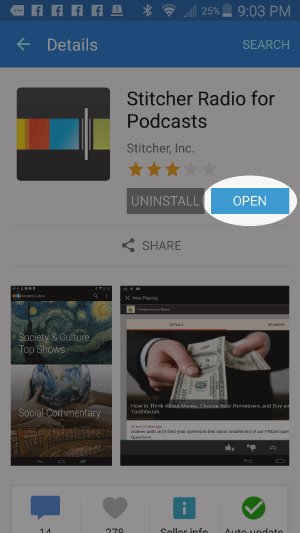
Listen on Stitcher (Android)
Install the Stitcher App
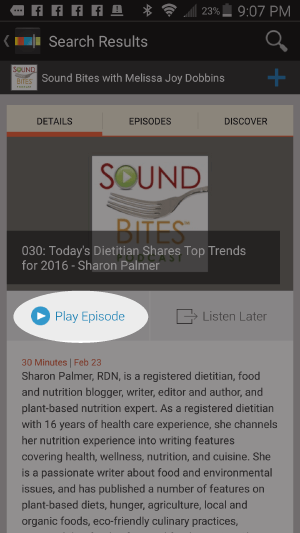
1. Search for “sound bites with melissa joy dobbins” 2. Choose Play Current Episode or Add to Playlist
Choose “Play Episode”
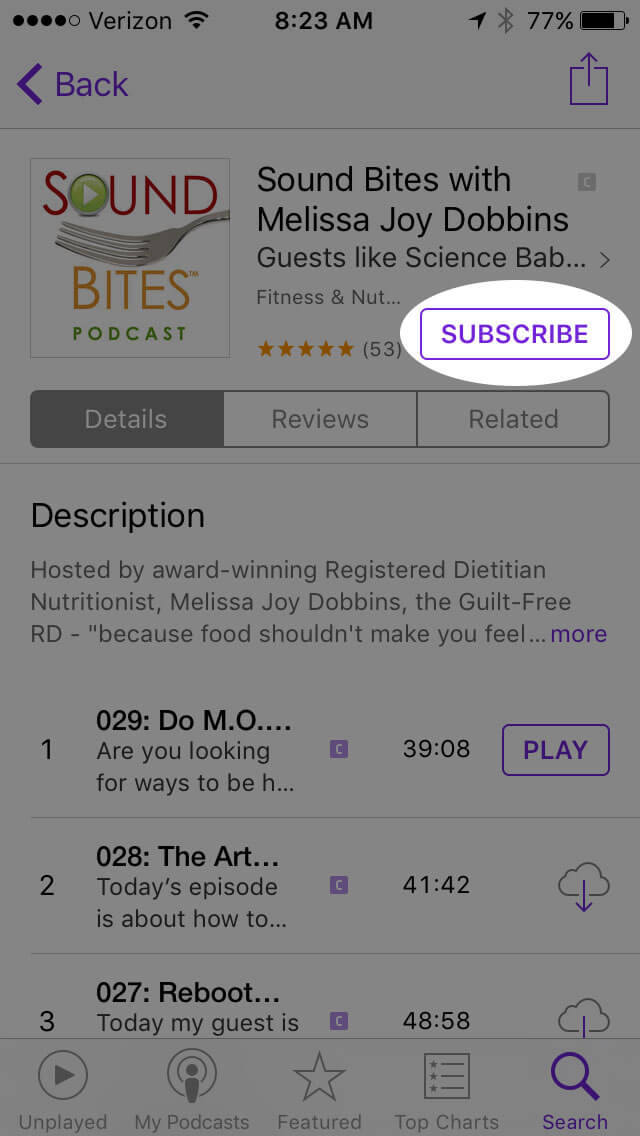
Subscribe & Review on iPhone
Open the “Podcast” app on your iPhone
Search for “Sound bites with melissa joy dobbins”
Open the podcast and click “Subscribe” and your done!
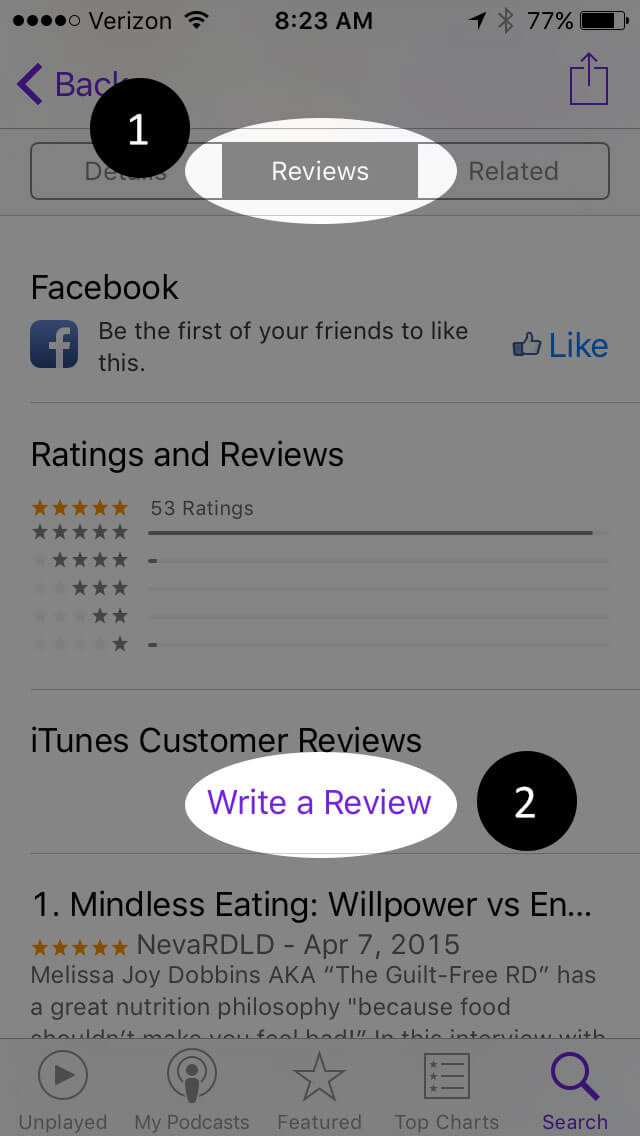
Write a Review
Click “Reviews”, then “Write a Review”.
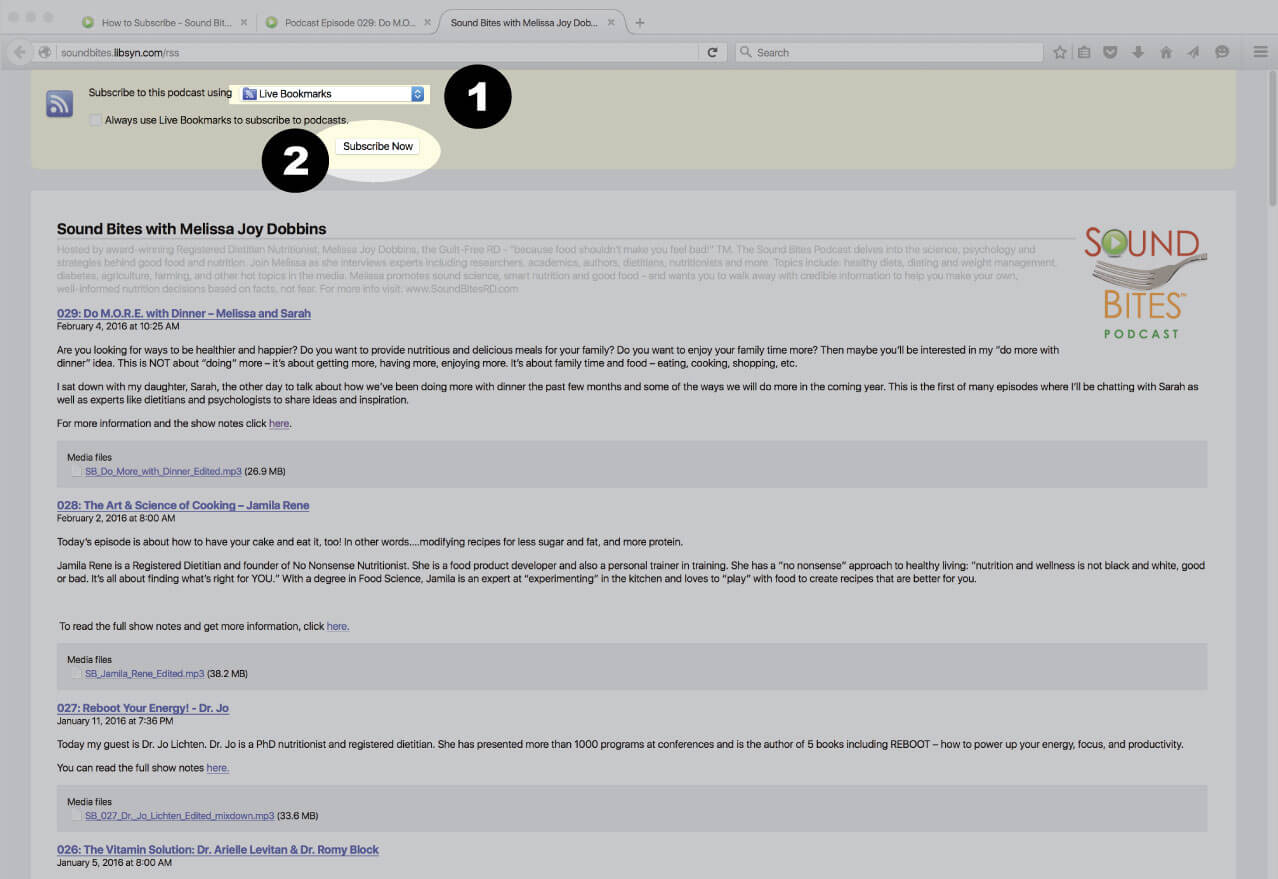
Subscribe via RSS Feed
Navigate to any podcast player . Click on the RSS feed icon.
Click on the RSS feed icon.
Click on RSS Feed
Choose which application you would like to use to receive the RSS feed
Click “Subscribe Now”
Confirm settings and subscribe.
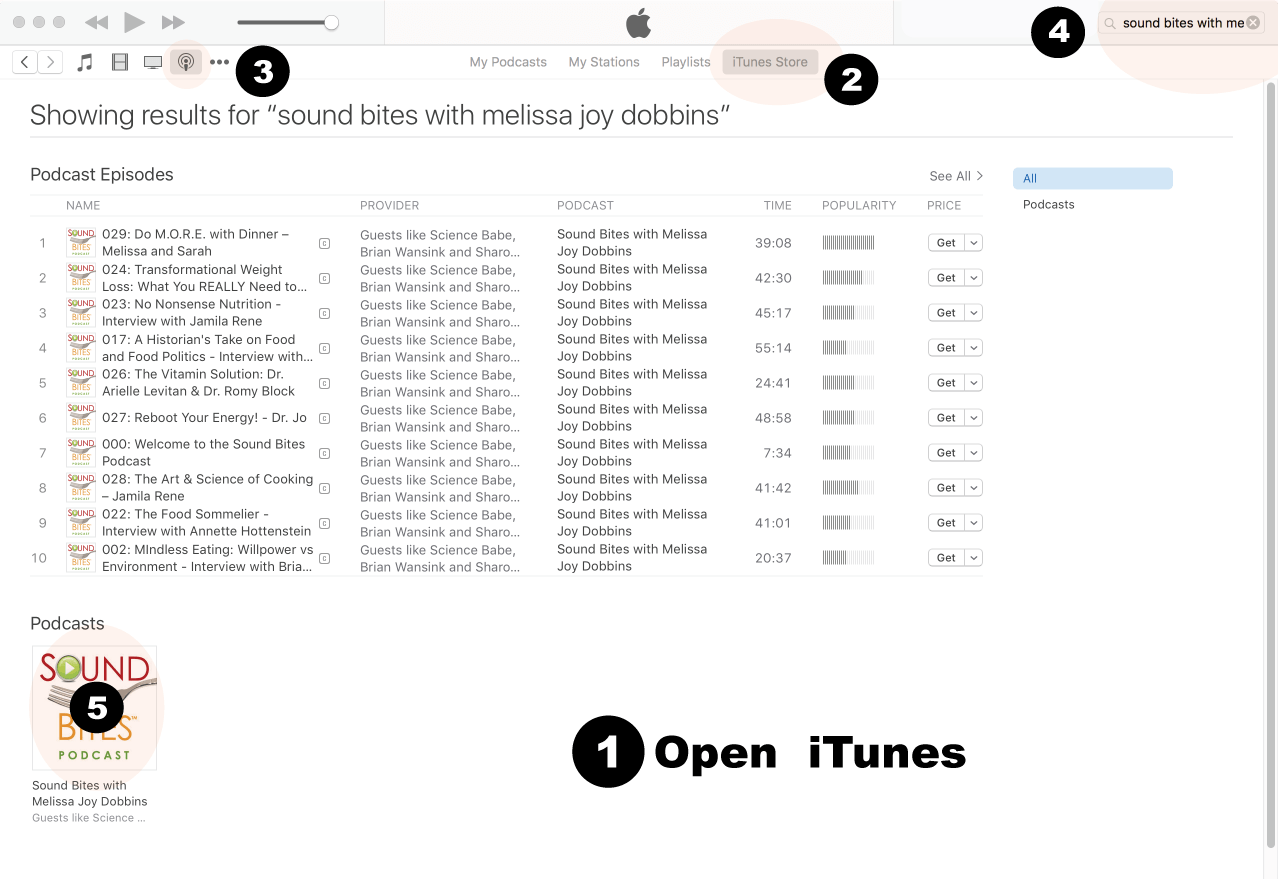
How to Review in iTunes
Open iTunes desktop application
Click iTunes Store
Click on Podcasts
Search for “Sound bites with Melissa Joy Dobbins”
Click on podcast image
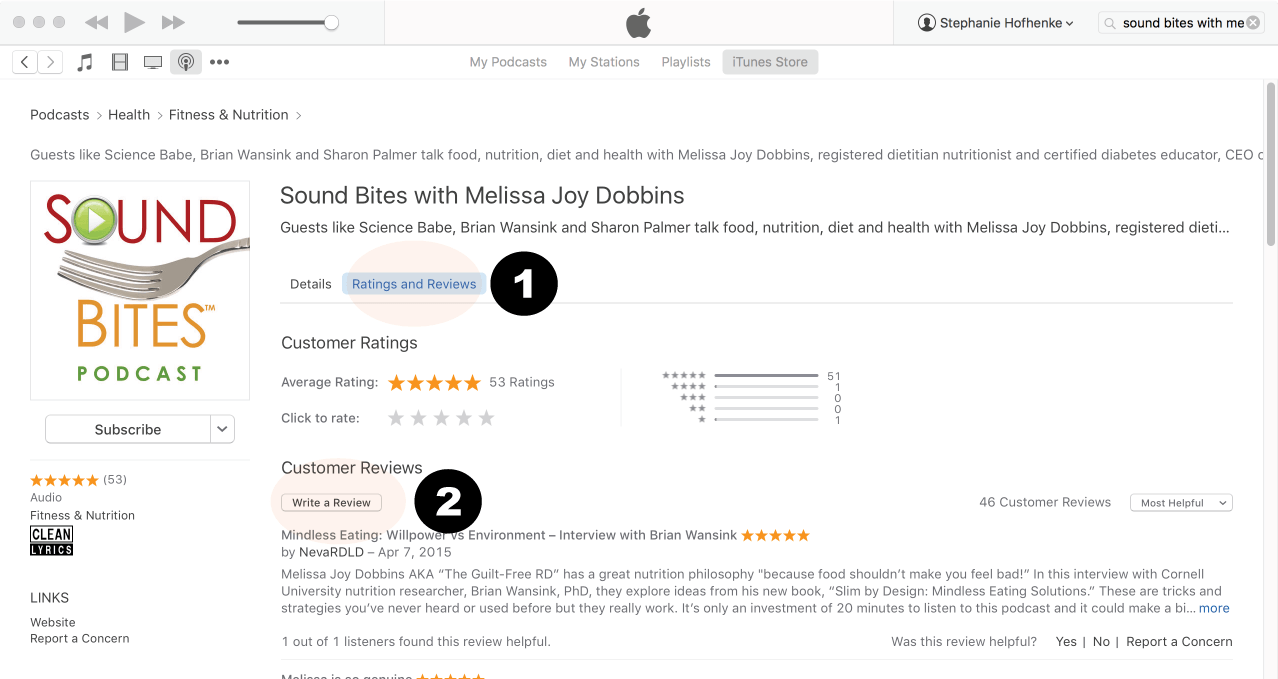
Search for Sound Bites podcast in iTunes
Click Ratings & Reivews
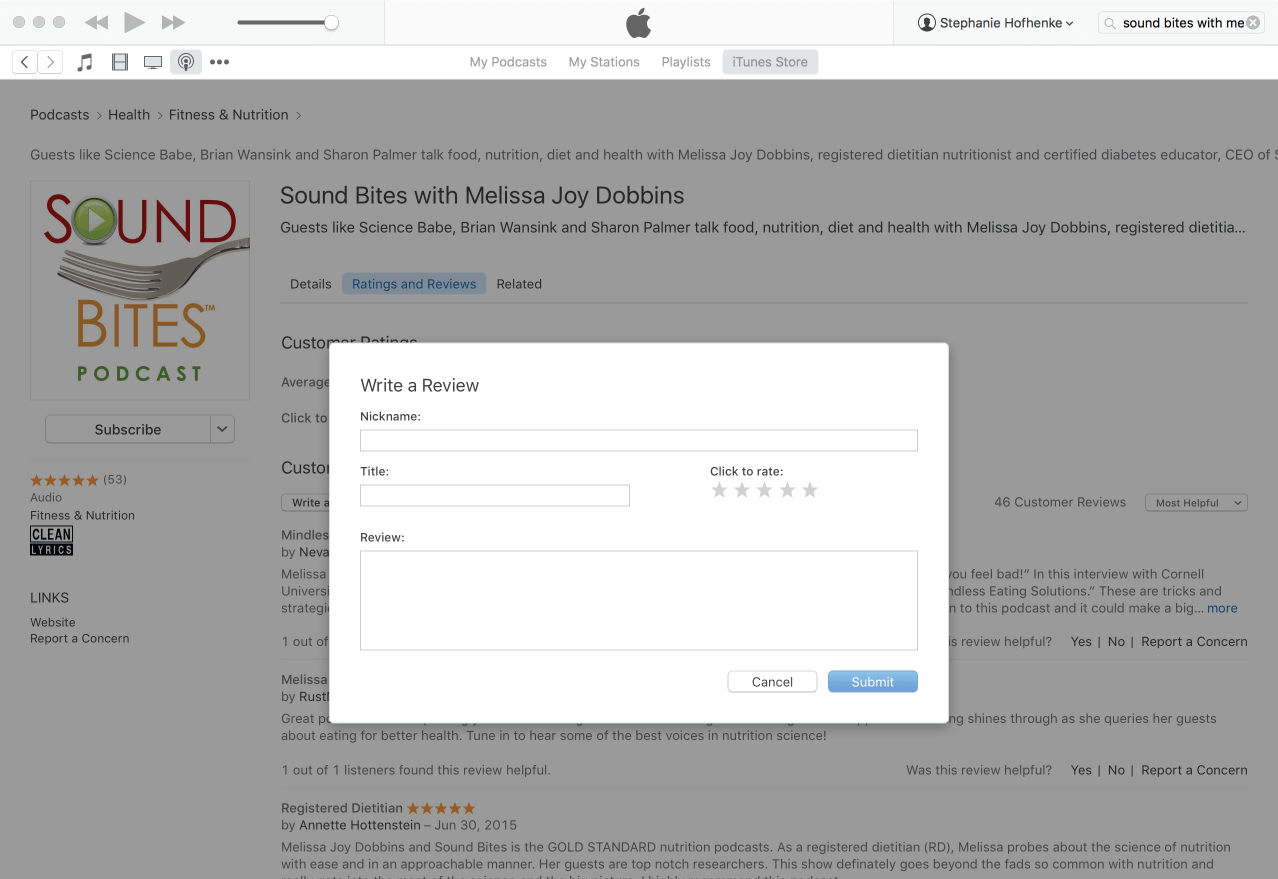
Click Write a Review
View reviews and write your own review.
Write your review…. Thank you!
Write your review!
How to subscribe via iTunes
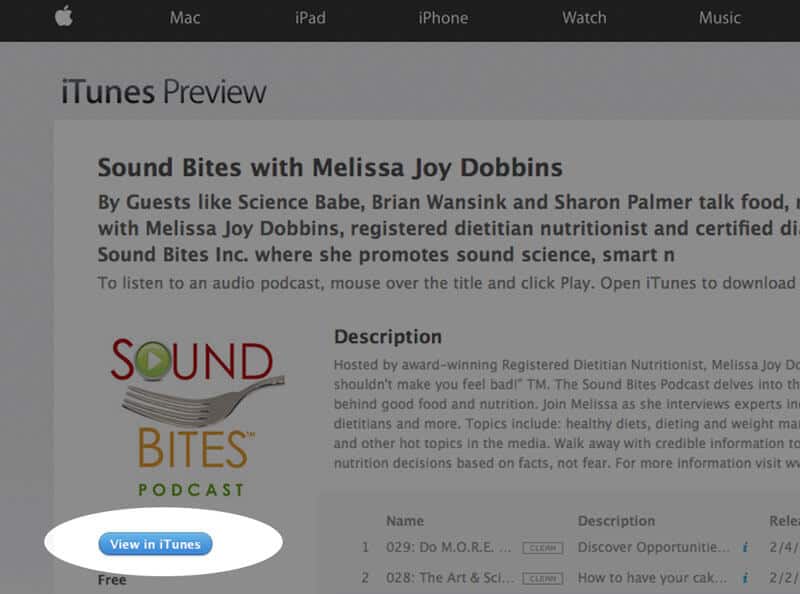
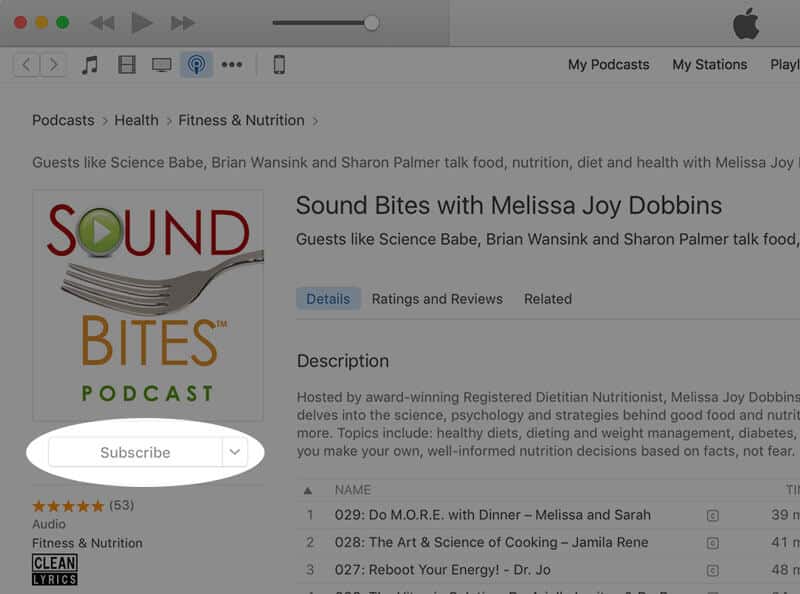
Click here to view the Sound Bites Podcastin iTunes, then click the blue “View in iTunes” button. This will open your iTunes application directly to Sound Bites Podcast. Click the “Subscribe” button, and your done!


















I always thought working in a grocery store would be great! Unfortunately, Lafayette, IN doesn’t offer that. Kroger in other states does have them.
I’ve just been an RD for 3.5 years, became an RD when I was 50. I worked at Purdue in dining for 22.5 years.
Did all food allergy training at Purdue
Created a Healthy Boiler nutrition education program
Love my job as an outpatient RD but my very busy pt schedule doesn’t leave me time to do other things. I want to do short cooking segments on IU FB page and other things, there just isn’t time.